Airline Approved Power Bank Guide: 100Wh FAA, TSA & IATA Math
Every airline approved power bank is regulated as a spare lithium-ion battery (UN 3480) banned from checked luggage. Convert mAh to Watt-hours using internal 3.7V cell voltage (100Wh = 27,027mAh) to verify approval-free carry-on eligibility, 101–160Wh operator limits, and laser-etched nameplate rules that prevent checkpoint rejection.
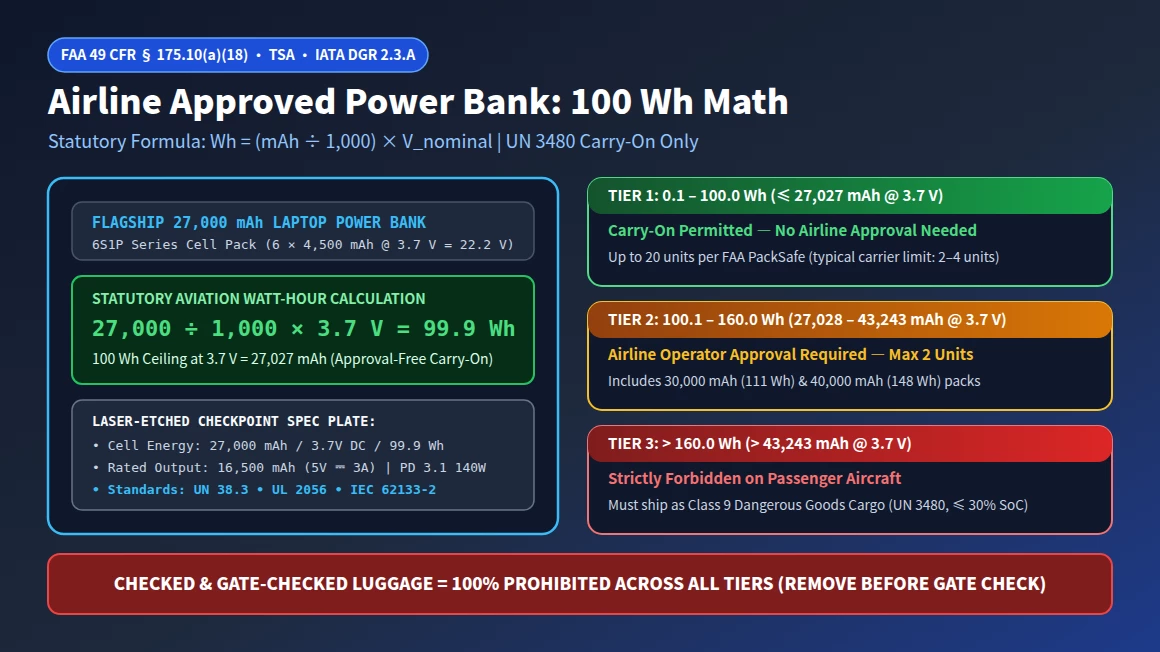
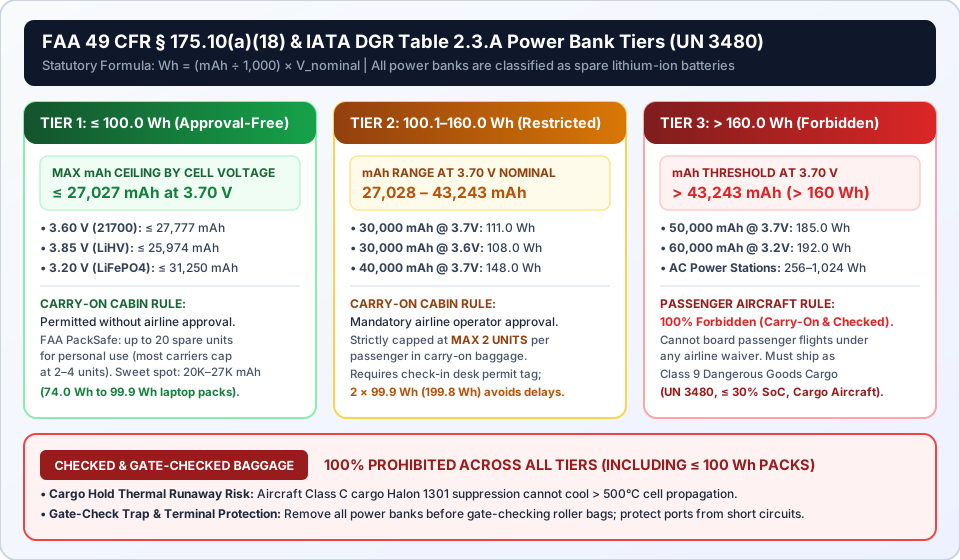
An airline approved power bank must not exceed 100 Watt-hours (100 Wh)—equivalent to 27,027 mAh at a standard 3.7 V internal lithium-ion cell voltage (Wh = mAh × 3.7 V ÷ 1,000)—to fly in carry-on cabin baggage without airline approval under FAA, TSA, and IATA rules. Packs rated 100.1–160 Wh require operator approval (max 2 units), unmarked units are rejected, and checked-baggage carriage is forbidden.
Updated: October 25, 2026
Travelers selecting the best airline approved power bank 100wh limit or packing a high-output power bank portable charger for laptops and phones lose hardware at airport checkpoints for three reasons: exceeding the 100 Wh (27,027 mAh at 3.7 V) approval-free threshold, leaving a battery inside a gate-checked roller bag, or carrying a pack whose silk-screened Wh rating has worn off. Use the statutory matrix below alongside our Charging & Power hub and Power Banks capacity and output hub to verify compliance before boarding.
Scroll horizontally to see all columns if needed.
| Regulatory Tier | Watt-Hour (Wh) Rating |
Max mAh at 3.7 V (and 3.6 V) |
Carry-On Cabin Rule | Checked & Gate-Checked Baggage | Airline Approval & Quantity Limit |
|---|---|---|---|---|---|
Tier 1: Standard Cabin-Approved (≤ 100 Wh) |
0.1 Wh – 100.0 Wh |
≤ 27,027 mAh at 3.7 V (≤ 27,777 mAh at 3.6 V) |
Permitted in carry-on cabin baggage | Strictly Forbidden (remove before gate-checking) | No airline approval required; up to 20 spare units per passenger under FAA PackSafe (2–4 typical carrier cap) |
Tier 2: Medium Extended (100.1–160 Wh) |
100.1 Wh – 160.0 Wh |
27,028 – 43,243 mAh at 3.7 V (27,778 – 44,444 mAh at 3.6 V) |
Permitted in carry-on only with prior approval | Strictly Forbidden | Mandatory airline operator approval; max 2 units per passenger under 49 CFR § 175.10(a)(18) and IATA DGR Table 2.3.A |
Tier 3: Prohibited High-Capacity (> 160 Wh) |
> 160.0 Wh |
> 43,243 mAh at 3.7 V (50,000 mAh / 185 Wh packs & power stations) |
Strictly Forbidden on passenger aircraft | Strictly Forbidden on passenger aircraft | Must ship as declared Class 9 Dangerous Goods Cargo (UN 3480) at ≤ 30% State of Charge on cargo aircraft |
Why Aviation Law Classifies Every Power Bank as a Spare Lithium-Ion Battery (UN 3480)
Aviation dangerous-goods rules separate batteries installed inside a computing device from external battery packs. Under U.S. hazardous-materials law (49 CFR § 175.10(a)(18)), FAA PackSafe Lithium Battery guidance, and IATA Dangerous Goods Regulations (DGR) Table 2.3.A (aligned with ICAO Doc 9284), every power bank portable charger, magnetic wireless battery, and removable smart-luggage battery is regulated as a spare (uninstalled) lithium-ion battery (UN 3480).
By contrast, a phone or laptop containing a permanent internal battery is classified under UN 3481 (Lithium ion batteries contained in equipment). Because a power bank’s primary function is to transfer electrical energy to other devices, regulators treat the entire housing as an exposed spare battery pack subject to zero-tolerance checked-baggage bans.
Thermal Runaway Physics and Cargo Hold Halon 1301 Suppression Limits
The ban on packing power banks in checked suitcases is grounded in fire physics documented in FAA Hazardous Materials Lithium Battery thermal-runaway resources:
- Exothermic Thermal Runaway (
> 500°C): When a lithium-ion pouch or cylindrical (18650/21700) cell suffers mechanical crushing in baggage conveyors or internal separator short-circuiting, it enters thermal runaway as its dominant failure mode. Cell temperatures climb past500°C to 600°C(932°F to 1,112°F), venting flammable gases (H₂,CO,CH₄,C₂H₄) while the cathode releases oxygen internally. - Cargo Hold
Halon 1301Limitation: Aircraft Class C cargo compartments use Halon 1301 (CF₃Br) gas suppression. Halon 1301 knocks down open flames in surrounding luggage, but it cannot cool a lithium-ion battery below its cell-to-cell thermal propagation threshold, allowing cells inside a checked bag to reignite repeatedly. - Cabin Cooling and Containment: Inside the passenger cabin, crew immediately detect smoke or heat, apply water or aqueous cooling liquids to stop cell-to-cell propagation, and place the pack inside a thermal containment bag.
The Gate-Checked Roller Bag Trap and Terminal Protection Rules
When overhead bins fill up at boarding, gate agents tag roller bags for planeside gate-checking into the cargo hold:
- Mandatory Gate-Check Removal (
49 CFR § 175.10(a)(18)): If your carry-on bag is checked at the gate or planeside, you must remove all power banks and spare lithium batteries and carry them into the cabin in your under-seat personal bag or pocket. - Individual Short-Circuit Protection: Under 49 CFR § 175.10(a)(18) and IATA DGR Table 2.3.A, protect every spare battery against short circuits using a protective pouch, recessed USB ports, or terminal covers away from loose coins and keys.
Rule of thumb: Never pack any power bank in checked luggage, and keep your power bank in your under-seat backpack rather than your overhead roller bag so an unexpected gate-check never sends a UN 3480 pack into the cargo hold.
Selection takeaway: Every power bank is regulated as a
UN 3480spare lithium-ion battery. Cabin carry-on placement with recessed, short-circuit-protected ports is mandatory whether the pack stores18.5 Wh(5,000 mAh) or99.9 Wh(27,000 mAh).
Watt-Hour (Wh) Conversion Math: Why 27,027 mAh (at 3.7 V) Is the 100 Wh Ceiling
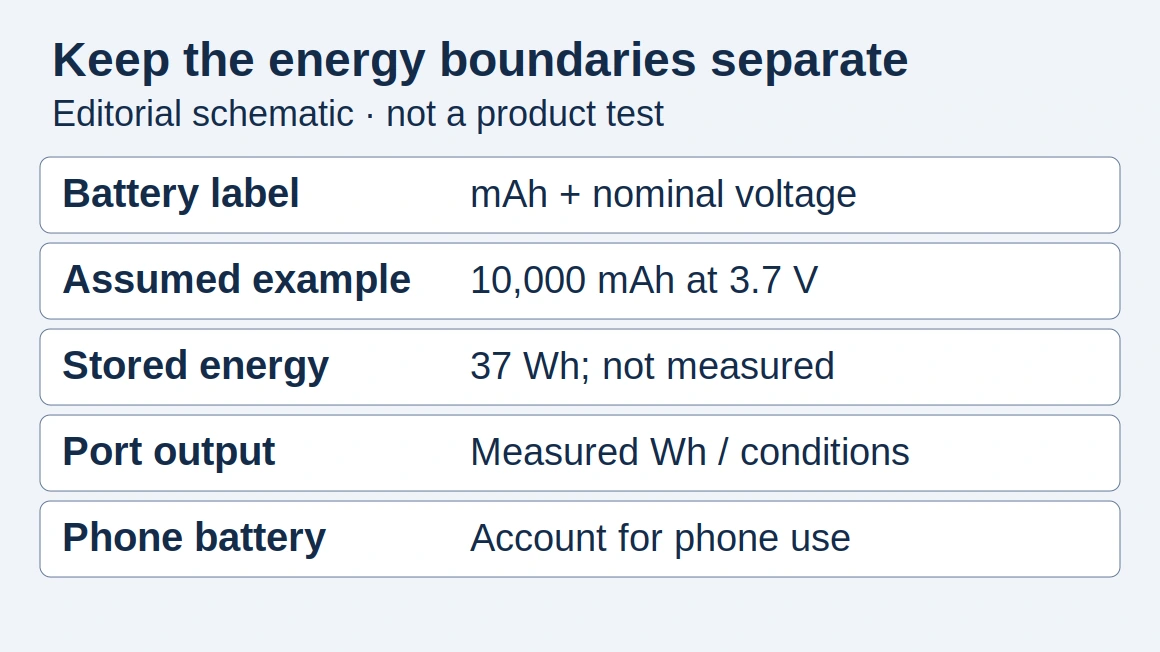
Aviation rules set limits in Watt-hours (Wh) rather than milliamp-hours (mAh) because mAh measures electrical charge (1 Ah = 3,600 C), whereas Wh measures total stored energy across the cell’s nominal voltage.
Per FAA PackSafe Watt-hour calculation instructions, convert any power bank’s capacity using these three equations:
- From Amp-hours (
Ah):Wh = Ah × V_nominal - From Milliamp-hours (
mAh):Wh = (mAh ÷ 1,000) × V_nominal - Inverse Maximum
mAhCeiling:mAh_max = (Wh_limit ÷ V_nominal) × 1,000
Why You Must Multiply by Internal Cell Voltage (3.6 V / 3.7 V), Never 5 V or 20 V USB Output
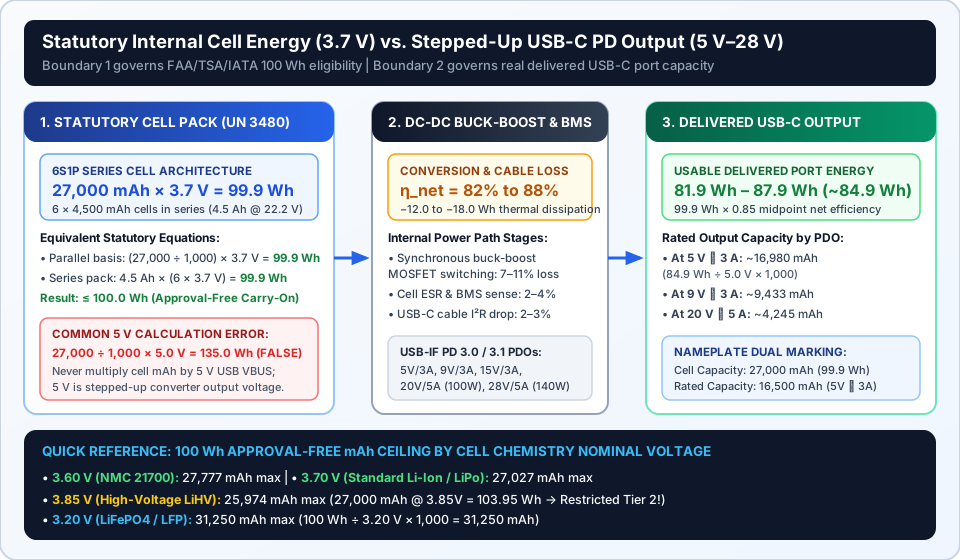
The most common calculation error is multiplying the advertised mAh capacity by the 5.0 V, 9.0 V, 15.0 V, or 20.0 V USB output voltage. As defined in the USB-IF USB Power Delivery specification and our USB-C Power Delivery explainer, USB-C VBUS rails (5 V–28 V) are stepped-up output voltages produced by an internal DC-DC converter. The headline mAh rating on a power bank portable charger (10,000 mAh, 20,000 mAh, or 27,000 mAh) is the sum of the internal lithium-ion cells’ capacities at their native electrochemical nominal voltage (3.60 V or 3.70 V for NMC / LCO cells).
Compare both calculations for a 27,000 mAh (3.70 V) laptop power bank:
- Worked example (Correct
3.70 Vcell basis):Wh = (27,000 mAh ÷ 1,000) × 3.70 V = 99.90 Wh(≤ 100.0 Wh, approval-free carry-on). - Worked example (False
5.00 VUSB output basis):(27,000 mAh ÷ 1,000) × 5.00 V = 135.00 Wh(wrong voltage basis, inflating energy by35.1%into the restricted100.1–160 Whtier).
Exact 100 Wh and 160 Wh mAh Ceilings Across Four Lithium Cell Chemistries
Because portable chargers use cylindrical 21700 cells, standard pouch LiPo cells, high-voltage LiHV cells, or LiFePO₄ cells, the exact mAh ceiling for 100.0 Wh shifts with nominal cell voltage:
- Standard
3.70 VNMC / LCO (18650,21700, Pouch LiPo):100 Whceiling:(100.0 Wh ÷ 3.70 V) × 1,000 = 27,027 mAh. Flagship best airline approved power bank 100wh limit laptop models are engineered at24,000 mAh(88.8 Wh),25,000 mAh(92.5 Wh),26,800 mAh(99.16 Wh), or27,000 mAh(99.90 Wh).160 Whceiling:(160.0 Wh ÷ 3.70 V) × 1,000 = 43,243 mAh.
- Low-Nominal
3.60 VCylindrical21700/18650Cells:100 Whceiling:(100.0 Wh ÷ 3.60 V) × 1,000 = 27,777 mAh(27,000 mAh × 3.60 V ÷ 1,000 = 97.20 Wh).160 Whceiling:44,444 mAh.
- High-Voltage
3.80 V – 3.85 VLiHV Pouch Cells (Ultra-Slim & Magnetic Packs):100 Whceiling:(100.0 Wh ÷ 3.85 V) × 1,000 = 25,974 mAh(26,315 mAhat3.80 V). A27,000 mAhpack built with3.85 Vcells equals103.95 Wh—exceeding100.0 Wh.
- Lithium Iron Phosphate (
LiFePO₄/LFP,3.20 VNominal):100 Whceiling:(100.0 Wh ÷ 3.20 V) × 1,000 = 31,250 mAh(50,000 mAhat160.0 Wh).
Series Cell Strings (4S / 6S) vs. Parallel-Equivalent mAh and Usable Port Energy
High-output USB-C PD laptop power banks (100 W–165 W, such as the multi-cell pack documented by Anker Support) wire 5 or 6 cells in series (5S1P at 18.5 V or 6S1P at 22.2 V) to reduce internal current and voltage drop when stepping up or down to 20 V ⎓ 5 A (100 W) or 28 V ⎓ 5 A (140 W). Both representations yield identical energy:
- Series pack (
6S1Pof4,500 mAh,3.7 Vcells):Wh_pack = 4.50 Ah × (6 × 3.70 V) = 4.50 Ah × 22.20 V = 99.90 Wh - Summed single-cell equivalent (
27,000 mAhat3.7 V):Wh_pack = (27,000 mAh ÷ 1,000) × 3.70 V = 99.90 Wh
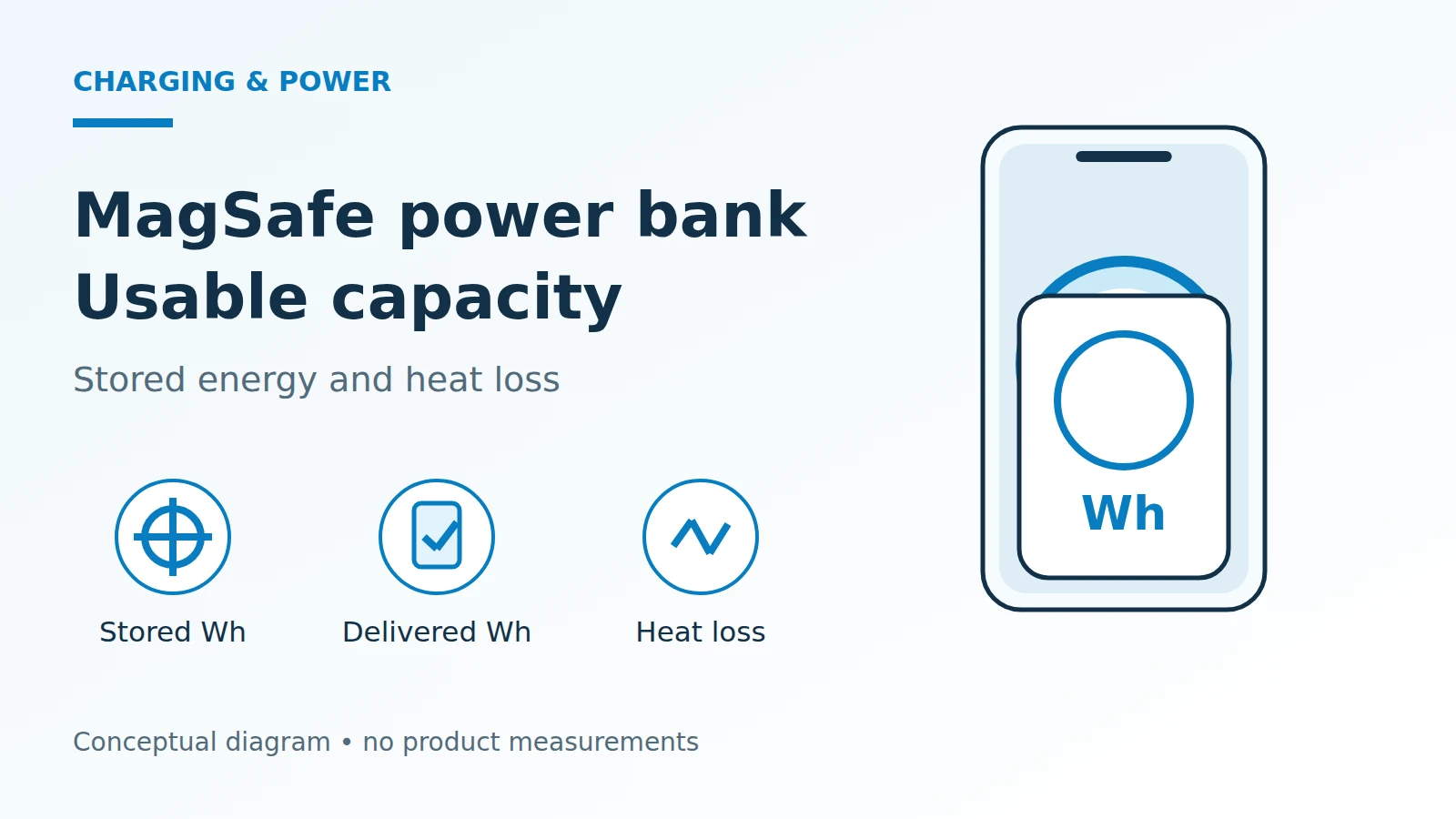
After synchronous buck-boost conversion and cable I²R voltage drop (η_net = 0.82 to 0.88, midpoint 0.85), usable port energy follows our Power Banks capacity and output guide and MagSafe power bank usable capacity guide:
Formula: Wh_delivered = Wh_nominal × η_net and Rated_Output_mAh(at V_bus) = (Wh_delivered ÷ V_bus) × 1,000
Scroll horizontally to see all columns if needed.
| Commercial Power Bank Class | Cell Architecture & Nominal Voltage | Advertised Capacity (mAh) |
Statutory Energy (Wh) |
Delivered Port Energy (82%–88% η) |
Rated Output mAh at 5V / 20V & Airport Status |
|---|---|---|---|---|---|
| Slim Magnetic Pack | 1S1P Pouch (3.70–3.85 V) |
5,000 mAh |
18.5–19.25 Wh |
15.2–16.9 Wh |
~3,100 mAh at 5V — Tier 1 Approval-Free |
| Daily Phone Pack | 2S1P / 1S2P (3.70 V) |
10,000 mAh |
37.0 Wh |
30.3–32.6 Wh |
~6,200 mAh at 5V / ~1,570 mAh at 20V — Tier 1 Approval-Free |
| Mainstream Travel Pack | 4S1P (4 × 5,000 mAh, 3.70 V) |
20,000 mAh |
74.0 Wh |
60.7–65.1 Wh |
~12,500 mAh at 5V / ~3,140 mAh at 20V — Tier 1 Approval-Free |
| 140W Laptop Pack | 6S1P (6 × 4,000 mAh, 3.70 V) |
24,000 mAh |
88.8 Wh |
72.8–78.1 Wh |
~15,000 mAh at 5V / ~3,770 mAh at 20V — Tier 1 Approval-Free |
| 25K 165W Laptop Pack | 5S1P (5 × 5,000 mAh, 3.60–3.70 V) |
25,000 mAh |
90.0–92.5 Wh |
73.8–81.4 Wh |
~15,500 mAh at 5V / ~3,880 mAh at 20V — Tier 1 Approval-Free |
| Classic 100Wh Pack | 8 × 3,350 mAh (3.70 V) |
26,800 mAh |
99.16 Wh |
81.3–87.3 Wh |
~16,800 mAh at 5V / ~4,210 mAh at 20V — Tier 1 Approval-Free |
| Flagship Max-Legal Pack | 6S1P (6 × 4,500 mAh, 3.70 V) |
27,000 mAh |
99.90 Wh |
81.9–87.9 Wh |
~16,980 mAh at 5V / ~4,245 mAh at 20V — Tier 1 Ceiling (≤ 100 Wh) |
| Heavy 30K Brick | 6 × 5,000 mAh (3.70 V) |
30,000 mAh |
111.0 Wh |
91.0–97.7 Wh |
~18,800 mAh at 5V — Tier 2: Airline Approval (Max 2) |
| 40K Expedition Brick | 8 × 5,000 mAh (3.70 V) |
40,000 mAh |
148.0 Wh |
121.4–130.2 Wh |
~25,100 mAh at 5V — Tier 2: Airline Approval (Max 2) |
| 50K Camp Power Bank | 10 × 5,000 mAh (3.70 V) |
50,000 mAh |
185.0 Wh |
151.7–162.8 Wh |
Tier 3 (> 160 Wh): Forbidden on Passenger Aircraft |
Rule of thumb: If a standard 3.7 V lithium-ion power bank exceeds 27,000 mAh (such as 30,000 mAh / 111 Wh), it crosses 100.0 Wh and requires prior airline operator approval.
Calculation takeaway: Verify
Wh = (mAh ÷ 1,000) × V_nominalusing3.6 Vor3.7 Vcell voltage. A27,000 mAh(99.9 Wh) pack delivers~82–88 Wh(~16,500–17,000 mAhat5 V) after buck-boost losses while remaining below the100.0 Whstatutory ceiling.
Airport Security Checkpoint Nameplate Rules: Why mAh-Only or Faded Labels Get Confiscated
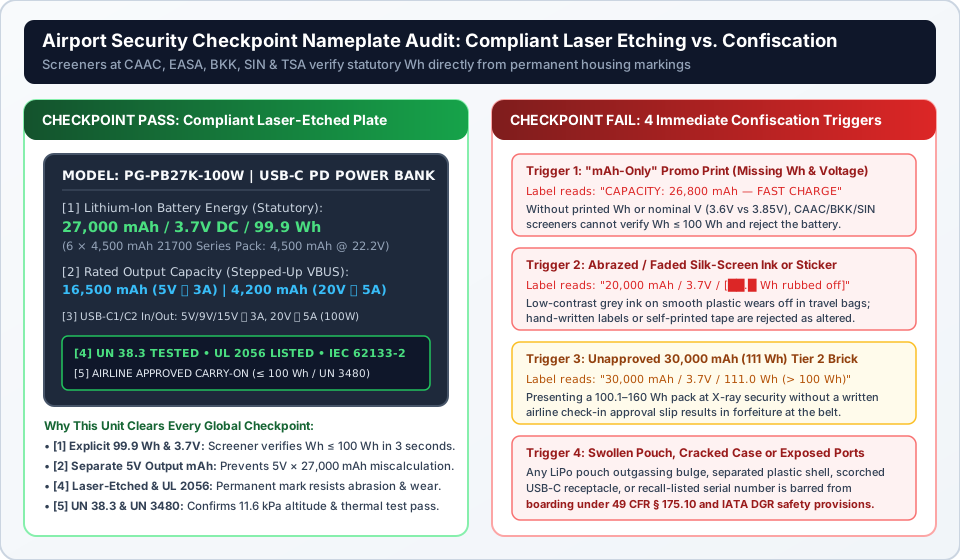
Staying below 100.0 Wh mathematically is not enough if security officers cannot verify the rating on the spot. Checkpoint screeners must confirm Watt-hours directly from the permanent manufacturer specification nameplate on the power bank enclosure.
How Checkpoint Enforcement Differs Across Global Aviation Hubs
While all ICAO states adopt the same 100 Wh / 160 Wh tiers under IATA DGR Table 2.3.A and EASA Dangerous Goods rules, physical nameplate verification varies by hub:
Scroll horizontally to see all columns if needed.
| Inspection Jurisdiction | Regulatory Basis | Nameplate Wh & Voltage Enforcement |
30,000 mAh (111 Wh) Handling |
In-Flight Usage & Overhead Bin Rules |
|---|---|---|---|---|
China (CAAC: PEK, PVG, CAN, SZX, HKG) |
CAAC Directive & ICAO Doc 9284 | 100% Manual Visual Audit: Missing Wh (without both mAh and V), faded ink, or taped stickers = immediate confiscation |
Confiscated unless accompanied by a stamped airline check-in approval slip | Strict In-Flight Ban: Charging or using power banks in flight or inside overhead bins is prohibited |
| Asia-Pacific Hubs (BKK, DMK, SIN, ICN, NRT, HND, TPE) | CAAT, CAAS, MLIT, MOLIT & IATA DGR | Strict Visual Audit: Every high-capacity pack is checked for legible Wh ≤ 100 Wh or mAh ≤ 27,000 mAh with nominal V |
Rejected at security unless check-in counter issued a cabin approval tag | Major carriers (Singapore Airlines, EVA Air, China Airlines, Korean Air, Thai Airways) ban in-flight power bank charging |
European Union & UK (EASA / CAA: FRA, AMS, CDG, LHR) |
EASA Dangerous Goods & ICAO Doc 9284 | CT Scanner + Officer Pull: High-density > 20,000 mAh packs are pulled for physical Wh nameplate confirmation |
Requires prior airline approval; several EU low-cost carriers cap at 100 Wh |
EASA requires keeping packs in cabin sight, never charging in overhead bins, and never moving seats if a pack drops into tracks |
United States (TSA & FAA) |
49 CFR § 175.10(a)(18) & FAA PackSafe | 3D CT Screening + Secondary Check: Oversized or unmarked battery bricks are inspected for ≤ 100 Wh compliance |
Permitted only with air-operator approval (max 2 units); barred from checked bags |
FAA advises keeping power banks in sight outside overhead bins and unplugging immediately if warm |
Anatomy of a Checkpoint-Proof Nameplate (UL 2056, UN 38.3, and IEC 62133-2)
Verify four physical and certification markings on the rear enclosure before purchasing a travel power bank:
- Laser-Etched or Molded-Recess Typography: Surface silk-screened grey ink on smooth plastic rubs off inside travel bags. Select laser-engraved anodized aluminum or recessed molded floor plates.
- Explicit Triple Electrical Marking (
mAh,V_nominal, andWh): RequireLithium-ion Battery: 27,000 mAh / 3.7V DC / 99.9 Whalongside a separateRated Output Capacity: 16,500 mAh (5V ⎓ 3A)line. UN 38.3Transport Test Compliance: Under IATA DGR Table 2.3.A, every air-transported lithium-ion design must pass UN Manual of Tests and Criteria Part III, Sub-section 38.3 (UN 38.3) (T111.6 kPaaltitude simulation,T2-40°C to +72°Cthermal cycling,T3vibration,T4shock,T557°Cexternal short circuit,T6impact/crush,T7overcharge, andT8forced discharge).UL 2056andIEC 62133-2Certification: In the UL Solutions Product iQ database,UL 2056(Outline of Investigation for Safety of Power Banks) verifies cell safety (UL 1642/IEC 62133-2), BMS short-circuit protection, and truthfulness of ratedmAhandWhnameplate markings. Cross-check marks via our UL, CE, and FCC electrical safety certifications guide.
Rule of thumb: Never fly internationally with a power bank that prints only "20000mAh" or "26800mAh" without an explicit Wh rating and nominal voltage (V); self-printed stickers are rejected as altered labels.
Selection takeaway: Require laser-etched or recessed markings showing
mAh,V, andWh(≤ 100.0 Wh) plusUN 38.3andUL 2056credentials so screeners can verify compliance in seconds.
Navigating the 100.1 Wh–160 Wh Tier, Airline Approval, and In-Flight Usage Rules
How 100.1 Wh–160 Wh Airline Operator Approval Works (and Why 2 × 99.9 Wh Beats 1 × 148 Wh)
Under 49 CFR § 175.10(a)(18) and IATA DGR Table 2.3.A, passengers may carry at most two (2) spare lithium-ion batteries rated 100.1–160.0 Wh (27,028–43,243 mAh at 3.7 V) in carry-on baggage only with explicit air-operator approval:
- Check-In Desk Clearance Before Security: You must stop at the airline’s staffed check-in desk before security, present the battery’s
Whplate, and obtain a written cabin approval slip. - Interline Rejection Risk: Approval from Airline A does not bind connecting Airline B, and several carriers restrict
100.1–160 Whapprovals to broadcast V-Mount camera packs or medical batteries. - Why Two
99.9 WhPacks Are Superior (199.8 WhApproval-Free): Carrying two27,000 mAh(99.9 Wh) power banks provides199.8 Whof combined energy—35%more than one40,000 mAh(148 Wh) brick—while clearing every checkpoint worldwide without airline paperwork.
In-Flight Charging Restrictions, Pass-Through Heat, and Seat-Track Crush Hazards
Per EASA Dangerous Goods passenger rules and FAA cabin safety guidance:
- No Overhead Bin Charging: Keep power banks in your under-seat bag or seat pocket within sight; never charge or discharge a power bank inside an overhead locker.
- No In-Flight Pass-Through Charging: Simultaneous recharging and discharging compounds internal buck-boost heat, as detailed in Anker’s pass-through charging documentation and our pass-through charging safety guide.
- Motorized Seat-Track Crush Protocol: If a battery slips between motorized seat cushions, never move the seat mechanism; call cabin crew immediately to prevent mechanical crush ignition.
Rule of thumb: Carry two 20,000–27,000 mAh (74–99.9 Wh) packs instead of one 30,000 mAh+ (> 100 Wh) brick, stow them under your seat, and recharge them at your hotel desk.
Selection takeaway: Two
99.9 Wh(27,000 mAh) carry-on packs deliver199.8 Whof total energy with zero airline approval paperwork and eliminate check-in counter delays.
Pre-Flight Power Bank Audit & Travel Kit Selection Worksheet
Recharging a depleted 99.9 Wh power bank at a hotel desk requires ~115 Wh of AC-DC input (~1.8 hours on a 65 W–100 W USB-C PD charger). Pair your 100–240 V charger with the proper country plug using our universal travel plug adapters and worldwide voltage guide, and match bedside multi-device docks using our 3-in-1 wireless charging station desk and travel selection guide.
Scroll horizontally to see all columns if needed.
| Audit Checkpoint | Statutory Requirement / Target Spec | Unit A | Unit B | Action If Unverified |
|---|---|---|---|---|
| 1. Nameplate Legibility | Laser-etched or recessed Wh, mAh, and V_nominal clearly readable |
___ | ___ | Retire from air travel: Faded ink or mAh-only packs risk checkpoint confiscation |
2. Statutory Energy (Wh) |
≤ 100.0 Wh (≤ 27,027 mAh at 3.7 V; ≤ 27,777 mAh at 3.6 V) |
___ | ___ | If 100.1–160.0 Wh, obtain airline check-in approval (max 2); if > 160 Wh, leave home |
| 3. Safety Certifications | UN 38.3, UL 2056 listing, and IEC 62133-2 / UL 1642 cells |
___ | ___ | Verify model in UL Product iQ and check recall notices |
| 4. Enclosure & Terminals | Zero pouch swelling, clean recessed ports, protective sleeve packed | ___ | ___ | Recycle swollen or dented packs; place compliant units in sleeves |
| 5. Baggage Placement | Stored in under-seat personal bag; never in checked or gate-checked bags | ___ | ___ | Transfer all power banks to personal backpack before the boarding gate |
Selection takeaway: Complete this five-point check 24 hours before departure so every power bank in your carry-on has a legible
≤ 100.0 Whlaser-etched nameplate and sits in your under-seat personal bag.
Frequently Asked Questions
What is the maximum mAh power bank allowed on a plane without airline approval?
Under 49 CFR § 175.10(a)(18), FAA PackSafe, TSA, and IATA DGR Table 2.3.A, the approval-free limit for a carry-on power bank is 100.0 Watt-hours (Wh). For a standard 3.70 V lithium-ion power bank, 100.0 Wh ÷ 3.70 V × 1,000 = 27,027 mAh—which is why commercial airline-approved laptop power banks top out at 24,000 mAh (88.8 Wh), 25,000 mAh (92.5 Wh), 26,800 mAh (99.16 Wh), or 27,000 mAh (99.90 Wh). At 3.60 V nominal (21700 cells), 100.0 Wh equals 27,777 mAh; at 3.85 V (LiHV cells), 100.0 Wh equals 25,974 mAh.
Can I bring a 30,000 mAh power bank on a plane?
A 30,000 mAh power bank using 3.70 V cells stores (30,000 ÷ 1,000) × 3.70 V = 111.0 Wh (108.0 Wh at 3.60 V). Because 108–111 Wh falls in the 100.1–160.0 Wh restricted tier, you cannot bring it through security without prior airline operator approval from the check-in desk (capped at 2 units in carry-on baggage). Carrying two 20,000 mAh (74.0 Wh) or 27,000 mAh (99.9 Wh) packs avoids airline rejections.
Why do you multiply mAh by 3.7V instead of 5V when calculating power bank Watt-hours for TSA and FAA?
Watt-hours (Wh) measure chemical energy stored inside the internal lithium-ion cells before voltage conversion. Standard lithium-ion (NMC / LCO) cells operate at 3.60 V or 3.70 V nominal voltage, and the advertised 20,000 mAh or 27,000 mAh cell capacity is measured at that 3.6 V–3.7 V level. The 5 V, 9 V, 15 V, or 20 V USB-C rating is the stepped-up bus voltage after DC-DC boost conversion. Multiplying cell mAh by 5.0 V falsely inflates stored energy by 35%.
Why are power banks banned in checked luggage even if they are switched off?
Aviation law classifies all power banks as spare lithium-ion batteries (UN 3480). If a checked suitcase suffers mechanical crushing in baggage-handling machinery or an internal cell short circuit occurs, the pack can enter thermal runaway (> 500°C), venting flammable electrolyte gases that aircraft Class C cargo-hold Halon 1301 suppression systems cannot cool below propagation temperature. Keep all power banks in cabin carry-on baggage and remove them before gate-checking any roller bag.
Will airport security confiscate a power bank if the capacity label is rubbed off or only shows mAh?
Yes, particularly at checkpoints in China (CAAC), Thailand (BKK/DMK), Singapore (SIN), Japan, South Korea, and European Union (EASA) airports. Screeners must verify Wh ≤ 100.0 Wh directly from the manufacturer’s permanent nameplate. If the Wh rating is missing and nominal voltage (V) is not printed beside mAh, or if silk-screened ink has worn off, officers confiscate the battery as unverified dangerous goods.
How this guide was prepared
Primary aviation hazardous-materials regulations, dangerous-goods transport tables, and battery safety standards from the U.S. Electronic Code of Federal Regulations (49 CFR § 175.10), the Federal Aviation Administration (FAA PackSafe), the International Air Transport Association (IATA Dangerous Goods Regulations Table 2.3.A), the European Union Aviation Safety Agency (EASA), UL Solutions (UL 2056), and the USB Implementers Forum (USB-IF), accessed October 25, 2026. Worked watt-hour equations, cell-chemistry voltage tables, and DC-DC buck-boost efficiency models illustrate statutory capacity boundaries and checkpoint inspection criteria.
Sources and further reading
- 49 CFR § 175.10(a)(18) — Exceptions for Passengers, Crewmembers, and Air Operators — U.S. eCFR (PHMSA / DOT). Accessed .
- PackSafe — Lithium Batteries (With Instruction and Watt-Hour Calculation) — Federal Aviation Administration. Accessed .
- FAA Hazardous Materials Resources — Lithium Batteries & Thermal Runaway — Federal Aviation Administration. Accessed .
- IATA Dangerous Goods Regulations — Lithium Batteries & Passenger Provisions (Table 2.3.A) — International Air Transport Association. Accessed .
- EASA Air Operations — Dangerous Goods & Passenger Lithium Battery Rules — European Union Aviation Safety Agency. Accessed .
- Product iQ: Certification Database (UL 2056 Power Banks & UL 1642 Cells) — UL Solutions. Accessed .
- USB Charger (USB Power Delivery) — USB-IF. Accessed .
- Understanding Pass-Through Charging in Anker Power Bank (25K, 165W) — Anker Support. Accessed .
Found an error? See our corrections policy and research methodology.