3-in-1 Wireless Charging Station: Desk and Travel Selection Guide
A 3-in-1 wireless charging station combines three independent inductive coils whose simultaneous load causes charging failures on standard 20W phone bricks. Verify the required 30W–36W USB-C PD input, match the smartwatch module to Apple Watch MFi or Samsung Galaxy Watch geometry, and compare weighted desk stands against foldable travel pads.
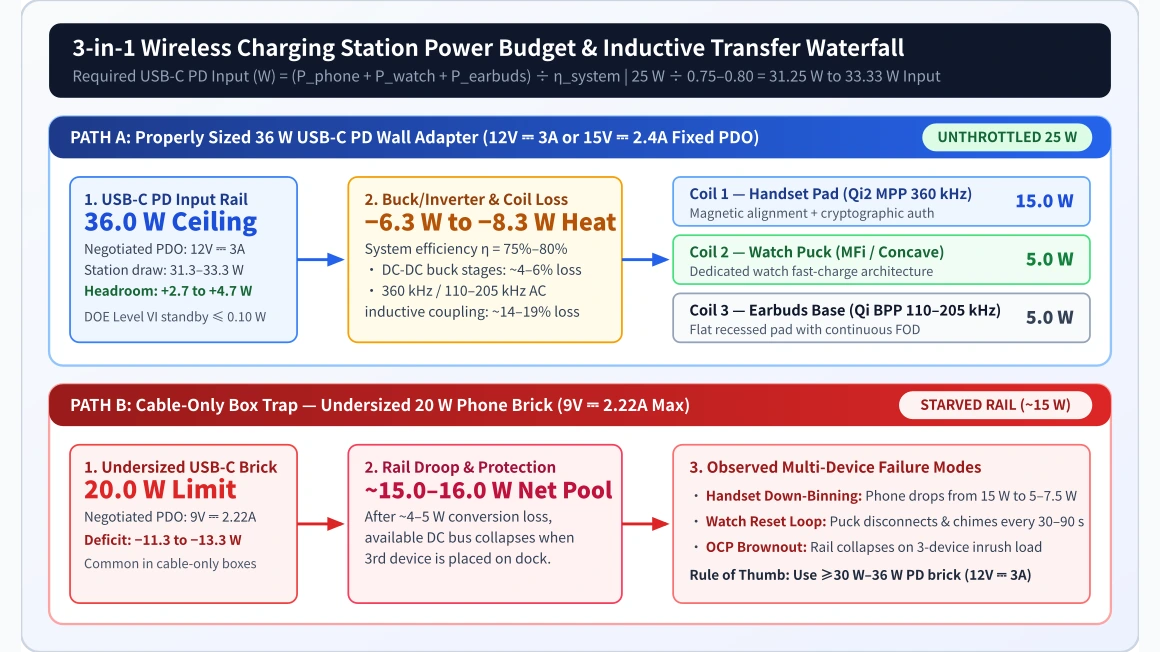
Selecting the wrong 3 in 1 wireless charging station—or pairing a three-coil dock with an undersized 20 W phone brick—causes input voltage droop, uncertified 7.5 W fallback, and repeated smartwatch charging failures. A true full-speed multi-device station requires a 30 W to 36 W USB-C Power Delivery wall adapter, verified Qi2 Magnetic Power Profile (MPP) certification on the primary handset pad, and a smartwatch module built for your exact watch ecosystem.
Updated: October 25, 2026
Whether you are evaluating a weighted qi2 3 in 1 charging stand for a permanent workstation or a foldable travel wireless charger for carry-on packing, treat the dock as three separate inductive power converters sharing a single DC input rail. Use the quick-specification matrix below to audit the adapter budget, magnetic profile, smartwatch cradle geometry, and thermal architecture before purchasing for personal use or corporate gift programs within a complete Charging & Power setup.
Scroll horizontally to see all columns if needed.
| Subsystem Checkpoint | Target Engineering Specification | Primary Standard / Verification Record | Dominant Failure Mode & Prevention |
|---|---|---|---|
| USB-C PD Input Adapter | 30 W (12V ⎓ 2.5A / 15V ⎓ 2A) to 36 W+ (12V ⎓ 3A / 15V ⎓ 2.4A) fixed PDO wall adapter bundled in box |
USB-IF USB Power Delivery & 10 CFR § 430.32(w) DOE Level VI | Input rail starvation: Running on a 18 W–20 W brick throttles the phone coil to 5 W–7.5 W and causes watch disconnect loops → confirm a 30 W–36 W PD brick is included |
| Primary Handset Coil | 15 W WPC Qi2 Magnetic Power Profile (MPP, 360 kHz) or Apple Made for MagSafe (MFM) |
WPC Qi2 Standard Overview | Uncertified BPP fallback: “MagSafe-compatible” rings without MPP authentication cap iPhones at 7.5 W (110–205 kHz) → verify model in WPC database |
| Smartwatch Module | Apple Watch MFi fast-charge module (~5 W) or Samsung dedicated concave BioActive cradle (~4.5 W–5 W) |
Apple Support Fast Charge Spec / Samsung Galaxy Watch7 Spec | Cross-brand coil rejection: Apple and Samsung watch pucks use opposite magnet polarities and incompatible recesses → never buy a single dock for mixed watch brands |
| TWS Earbuds Base Pad | 5 W flat WPC Qi Baseline Power Profile (BPP, 110–205 kHz) with Foreign Object Detection (FOD) |
WPC Qi v2.0 Certification Rollout | Eddy-current heating: Metal keychains, coins, or thick metallic cases on the flat pad induce stray heat → keep the base clear and verify active FOD shutdown |
| Chassis & Thermal Path | Desk stand: ≥ 300 g weighted metal base + open rear airflow; Travel: 2-axis metal hinge + 90° flip-up watch puck |
Apple Ambient Operating Range (0°C–35°C) | Thermal charging hold (>80%) & crease fatigue: Flat silicone travel pads trap heat and fracture ribbon traces at the fold → prefer elevated stands or hinged travel cubes |
Why Input Power Budgeting Makes or Breaks a 3-in-1 Wireless Charging Station
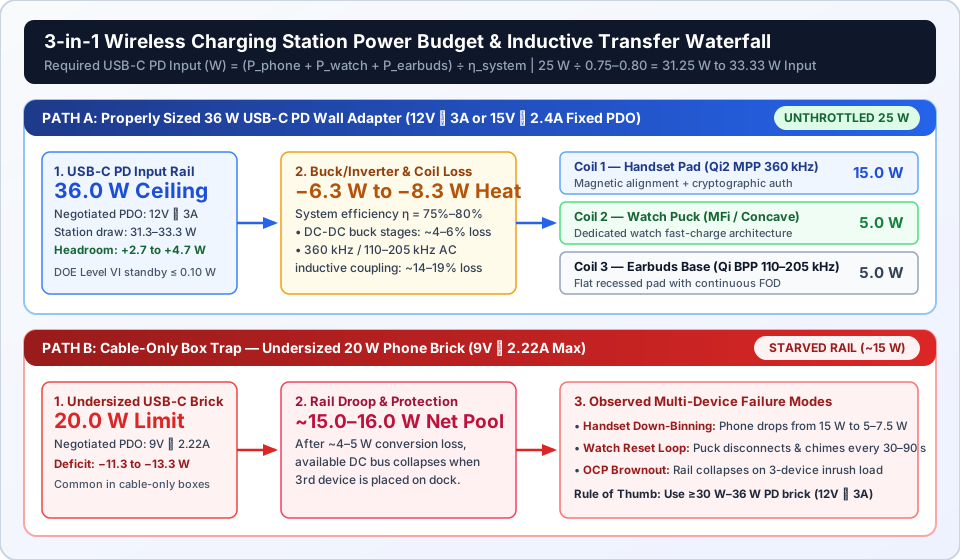
A 3-in-1 wireless charging station houses a USB-C Power Delivery sink controller, multiple DC-DC buck regulators, and three independent DC-AC inverter stages driving separate transmitter coils. When a smartphone, smartwatch, and true wireless stereo (TWS) earbud case charge simultaneously, the internal power rail must sustain all three inductive loads plus conversion and coupling losses.
To size the wall adapter correctly, sum the wireless power delivered to each receiver and divide by the combined system efficiency of the station:
Formula: Required USB-C PD Input Power (W) = (P_phone + P_watch + P_earbuds) ÷ η_system
In a full-speed 3-in-1 configuration:
- Primary handset coil (
P_phone):15.0 Wvia WPC Qi2 Magnetic Power Profile (MPP) or Apple MagSafe. - Smartwatch fast-charge module (
P_watch):5.0 Wallocated to the watch transmitter module. - TWS earbuds base pad (
P_earbuds):5.0 Wallocated to the flat Qi Baseline Power Profile (BPP) pad. - Combined transmitted wireless output:
15.0 W + 5.0 W + 5.0 W = 25.0 W.
Across multi-coil inductive transmitters, end-to-end system efficiency (η_system) from the USB-C receptacle to the regulated DC output inside the receiving devices ranges from 0.75 (75%) to 0.82 (82%). Internal buck regulation consumes 4% to 6%, while AC coil resistance, ferrite core losses, and magnetic flux leakage across a 2 mm to 3 mm case gap consume 14% to 19%.
- Worked example at
80%system efficiency (η_system = 0.80):25.0 W ÷ 0.80 = 31.25 Wrequired at the USB-C input port. - Worked example at
75%system efficiency (η_system = 0.75):25.0 W ÷ 0.75 = 33.33 Wrequired at the USB-C input port.
Because 31.25 W to 33.33 W exceeds 18 W (9V ⎓ 2A), 20 W (9V ⎓ 2.22A), and 27 W (9V ⎓ 3A) adapters, a full-speed 3-in-1 station must negotiate a 12V ⎓ 2.5A (30 W), 12V ⎓ 3A (36 W), 15V ⎓ 2A (30 W), or 15V ⎓ 2.4A (36 W) Fixed Power Data Object (PDO) under the USB-IF USB Power Delivery specification. Review fixed PDO stepping in our USB-C Power Delivery explainer.
The “Cable-Only Box” Trap and Dynamic Down-Binning
Many lower-priced 3-in-1 docks include only a USB-C cable in the box. Plugging that dock into a 20 W (9V ⎓ 2.22A) phone brick leaves only 15 W to 16 W of net wireless power after conversion losses, triggering three failure modes when multiple devices are placed on the stand:
- Silent Handset Down-Binning: The station detects the
9V ⎓ 2.22A(20 W) input limit and throttles the primary phone coil from15 Wdown to7.5 Wor5 W. - Cyclical Smartwatch Connect/Disconnect Loops: Simultaneous inrush current trips adapter over-current protection (
OCP) or drops the internal 9V bus below under-voltage lockout (UVLO), causing the smartwatch screen to chime and reset every 30 to 90 seconds. - Multiport Shared-Adapter Dropouts: Plugging a 3-in-1 dock into a shared multiport GaN charger causes temporary power resets whenever another USB-C port is connected. Check our intelligent dynamic multi-port power distribution guide to ensure the port feeding your dock retains
30 W to 36 Wcontinuously.
Rule of thumb: Never operate a 15 W + 5 W + 5 W 3-in-1 wireless charging station from an adapter rated below 30 W (12V ⎓ 2.5A or 15V ⎓ 2A); specify a bundled 36 W (12V ⎓ 3A or 15V ⎓ 2.4A) USB-C PD adapter for unthrottled three-device operation.
Selection takeaway: Check the “What’s in the Box” line before comparing prices. A 3-in-1 station without a
30 W–36 WUSB-C PD brick requires a separate$15–$25adapter purchase to avoid 7.5 W phone throttling and watch resets.
Qi2 Magnetic Power Profile (MPP) vs. Uncertified “MagSafe-Compatible” Stands
The largest performance gap in desktop wireless charging separates certified qi2 3 in 1 charging stand hardware from uncertified stands labeled “MagSafe-compatible” or “15W magnetic.” Physical magnet attraction only confirms a permanent neodymium ring beneath the surface; it does not establish which power profile runs on the coil.
Per the Wireless Power Consortium Qi and Qi2 standard overview and the WPC Qi v2.0 profiles and certification rollout specification note, WPC Qi v2.0 separates magnetic and non-magnetic operation:
- Magnetic Power Profile (
MPP): Based on Apple MagSafe technology, Qi2 MPP uses a permanent magnet ring for sub-millimeter coil alignment, runs cryptographic authentication, and shifts operating frequency to360 kHzto deliver15 W(with Qi2.2 extending high-power MPP up to25 Won newer devices). - Extended Power Profile (
EPP): A non-magnetic Qi v2.0 profile for flat pads and multi-coil cradles without permanent alignment magnets. - Uncertified “Magnetic” Baseline Power Profile (
BPP): Budget stands pair an uncertified magnet ring with a legacy Qi v1.x BPP transmitter at110 kHz to 205 kHz, which Apple iPhones (iPhone 12 through iPhone 16 series) restrict to7.5 W.
Scroll horizontally to see all columns if needed.
| Handset Pad Architecture | Operating Frequency | Authenticated Handshake | Maximum iPhone Wireless Rate | Coil Alignment & Eddy-Current Profile |
|---|---|---|---|---|
| WPC Certified Qi2 (MPP) | 360 kHz (MPP mode) |
Required WPC cryptographic storage authentication | 15 W (iPhone 12–16 series) |
Precision magnetic ring minimizes radial offset and stray flux heating |
| Apple Made for MagSafe (MFM) | 360 kHz (Apple MagSafe) |
Required Apple MFi authentication coprocessor | 15 W (up to 25 W on rev.2 puck) |
Official Apple magnetic ring geometry and MFM badge |
| Uncertified “MagSafe-Compatible” (BPP) | 110 kHz–205 kHz |
None (legacy BPP ping) | Capped at 7.5 W |
Loose magnet tolerance increases off-axis eddy-current heat |
Verify the exact model in our Qi2 wireless charger Magnetic Power Profile guide and look for the official Qi2 logo. Keep phone cases at or below 2.5 mm to 3.0 mm with an integrated magnetic ring to preserve vertical holding force and inductive coupling.
Selection takeaway: Treat any “MagSafe-compatible 15W” stand as a
7.5 WiPhone charger unless it carries a verified WPC Qi2 MPP certification record or Apple Made for MagSafe badge.
Smartwatch Coil Ecosystem Split: Apple Watch MFi vs. Samsung Galaxy Watch
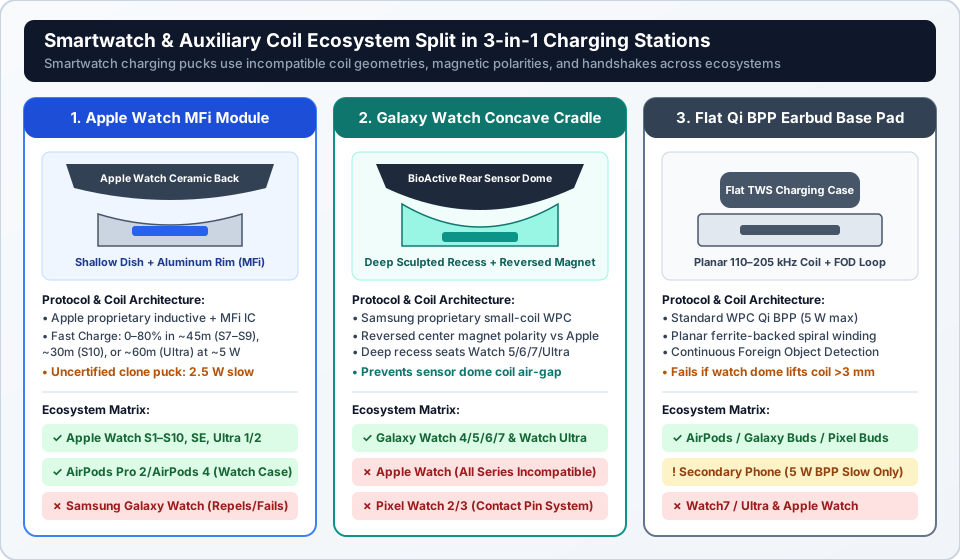
While smartphones and earbud cases share planar WPC Qi receivers, smartwatch pucks on a 3-in-1 wireless charging station are locked to a single brand due to incompatible coil diameters, rear sensor domes, magnet polarities, and charging protocols.
1. Apple Watch MFi Fast-Charge Module vs. Legacy 2.5 W Pucks
Per Apple’s fast charge documentation for Apple Watch, Apple Watch Series 7, Series 8, Series 9, Series 10, and Apple Watch Ultra / Ultra 2 reach 0% to 80% in approximately 45 minutes on Series 7–9 (~30 minutes on Series 10; ~60 minutes on Ultra/Ultra 2) when paired with an Apple MFi-certified fast-charging module and a 5 W watch power allocation. Uncertified clone pucks on budget 3-in-1 stands cap charging at ~2.5 W (110–150 minutes full charge) and frequently trigger watchOS accessory compatibility warnings after firmware updates.
2. Samsung Galaxy Watch Concave BioActive Sensor Geometry
An Apple Watch 3-in-1 dock cannot charge a Samsung Galaxy Watch, and vice versa. As documented in the Samsung Galaxy Watch7 specifications and BioActive sensor overview, Galaxy Watch5, Watch6, Watch7, and Galaxy Watch Ultra feature a protruding rear optical BioActive Sensor dome, a proprietary WPC-derived small coil, and reversed center magnet polarity compared to Apple Watch. Because the deeper sensor dome on Galaxy Watch7 and Watch Ultra creates an excessive coil air-gap on flat pads, Samsung watches require a dedicated deep-concave Samsung watch cradle.
3. TWS Earbuds Base Pad (5 W Flat Qi BPP and FOD Protection)
The recessed base pad is a planar WPC Qi Baseline Power Profile (BPP) coil (110–205 kHz, 5 W max) that charges AirPods (MagSafe/Wireless Case), Galaxy Buds, and Pixel Buds at 2.5 W to 3.5 W. Certified Qi bases continuously monitor coil Q-factor and power-loss accounting for Foreign Object Detection (FOD), shutting off power if coins, keys, or metal rings rest on the deck.
Selection takeaway: Confirm the user’s exact watch brand first: specify an Apple MFi fast-charge module for Apple Watch Series 7–10/Ultra, or a deep-concave Samsung cradle for Galaxy Watch5/6/7/Ultra.
Desk Stand vs. Foldable Travel Charger: Mechanics, Thermals, and Bedside Ergonomics
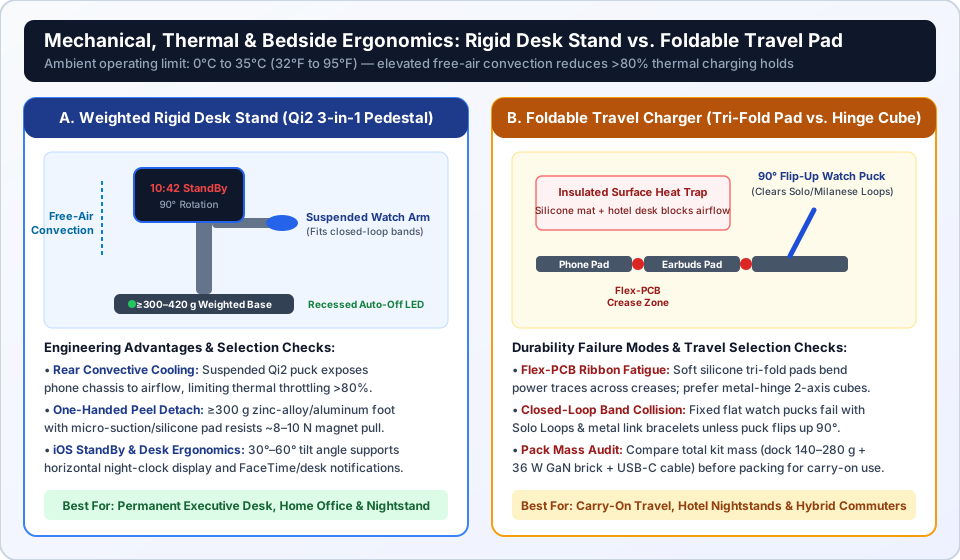
Once power budget and watch compatibility are verified, choose between a rigid weighted qi2 3 in 1 charging stand for permanent desks and a foldable travel wireless charger for carry-on kits.
1. Weighted Rigid Desk Stand Mechanics & Open-Air Convection
An elevated metal pedestal solves three everyday workstation and bedside problems:
- One-Handed Peel Detachment (
≥ 300 gBase Mass): Qi2 MPP and MagSafe magnets exert8 N to 10 Nof pull force. Lightweight plastic stands (< 180 g) lift off the table when you grab your phone.- Rule of thumb: Select a rigid desk stand with a chassis mass of
≥ 300 g to 420 gand a high-friction silicone footplate so you can tilt-peel the phone off with one hand.
- Rule of thumb: Select a rigid desk stand with a chassis mass of
- Rear Free-Air Convective Cooling: Per Apple’s iPhone and iPad thermal operating guidelines, iOS devices operate best in
0°C to 35°C(32°F to 95°F) ambient air and pause charging above80%if the battery overheats. Suspending the handset in open air dissipates inductive heat far faster than laying it on an insulated mat. Compare portable magnetic thermal losses in our MagSafe power bank usable capacity and heat-loss guide. - iOS StandBy Mode & Viewing Tilt: Rotating a magnetically mounted iPhone
90°horizontally activates iOS StandBy mode for red-tinted bedroom night clocks and angled (30°–60°) desk notifications.
2. Foldable Travel Wireless Charger Durability & Band Clearance
A foldable travel wireless charger compresses three coils into a pocket-sized housing (15 mm to 30 mm thick), but introduces two mechanical checkpoints:
Scroll horizontally to see all columns if needed.
| Design Parameter | Rigid Weighted Desk Stand | Hinged Folding Cube / Stand | Soft Silicone Tri-Fold Pad |
|---|---|---|---|
| Typical Unit Mass (Dock Only) | 300 g to 480 g |
180 g to 270 g |
110 g to 165 g |
| One-Handed Phone Detach | Yes (weighted metal footplate) | Moderate (two-finger base hold) | No (flat pad lifts with magnet) |
| Landscape StandBy / Viewing Tilt | 30°–60° pedestal mount |
0°–65° friction-hinge lid |
Flat (0°) unless folded into triangle |
| Closed-Loop Watch Band Fit | Yes (suspended watch arm) | Yes (90° pop-out watch puck) |
Only if watch puck flips up 90° |
| Hinge / Ribbon Fatigue Resistance | Fixed internal wiring | Coaxial wire through metal barrel | High risk of flex-PCB trace cracking at fold crease |
| Rear Handset Thermal Path | Open 360° air convection | Elevated when unfolded as stand | Silicone mat traps heat against table |
- Flex-PCB Crease Fatigue: Soft tri-fold silicone pads bend flat flexible printed circuit (
FPC) copper traces across two folding creases; repeated tight packing work-hardens and fractures those traces. Dual-axis aluminum hinge cubes routing stranded coaxial wire through metal barrels resist fatigue. - Closed-Loop Watch Strap Clearance: Fixed lay-flat watch pucks cannot charge watches fitted with closed Apple Solo Loops, Braided Solo Loops, Milanese Loops, or link bracelets. Require a watch module that flips up
90°. For international trips, pair your100–240VUSB-C PD brick with the correct plug interface using our universal travel plug adapters and worldwide voltage guide.
3. Bedside Status LED & Acoustic Whine Checklist
For bedroom nightstands, select a dock with a downward-facing or auto-extinguishing status LED (10–30 s timeout) rather than a forward-firing blue/green LED, and verify damped multi-layer ceramic capacitors (MLCCs) so 110–360 kHz switching does not produce audible coil whine near a pillow.
Selection takeaway: Choose a
≥ 300 grigid pedestal stand for permanent desks and nightstands; choose a metal-hinged folding cube with a90°flip-up watch puck for travel.
Regulatory Compliance, Standby Drain, and Procurement Verification Worksheet
1. FCC Part 15 / Part 18 Authorization & UL 62368-1 Adapter Listing
Multi-coil wireless chargers operate intentional inductive radiators across 110–205 kHz, 360 kHz, and watch carrier frequencies, requiring an FCC ID equipment authorization grant under 47 CFR Part 15 radio frequency device rules and Part 18. The bundled AC-DC wall adapter must carry a recognized NRTL safety listing (UL, ETL, or CSA to UL 62368-1), which you can verify using our guide to UL, CE, and FCC electrical safety certifications.
2. DOE Level VI Efficiency vs. Continuous 3-Coil Standby Draw
Under 10 CFR § 430.32(w) energy conservation standards for external power supplies, an external AC-DC wall adapter rated ≤ 49 W must meet DOE Efficiency Level VI (≤ 0.10 W no-load standby power with the adapter unplugged from the dock). Once the 3-in-1 wireless dock remains connected to the adapter, continuous 3-coil FOD ping polling draws 0.4 W to 1.2 W (~3.5 to 10.5 kWh/year), which you can log using our phone charger standby phantom power drain guide.
3. Reproducible 3-in-1 Station Selection & Corporate Gift Procurement Worksheet
Use this verification record when comparing models or standardizing a corporate gift kit alongside our Phone Accessories hub and Charging & Power hub:
Scroll horizontally to see all columns if needed.
| Verification Field | Target Requirement | Candidate Model A | Candidate Model B | Evidence / Database Record |
|---|---|---|---|---|
| Recipient Handset & Watch Ecosystem | Confirm 100% iPhone + Apple Watch or Samsung Galaxy + Galaxy Watch | ___ | ___ | Never deploy an Apple Watch dock to Galaxy Watch users |
| Primary Handset Coil Certification | WPC Qi2 MPP (15 W at 360 kHz) or Apple MFM |
___ | ___ | Match exact model number in WPC Certified Product Database |
| Smartwatch Module Specification | Apple MFi Fast-Charge (0–80% ~45m S7–9 / ~30m S10) or Samsung Concave Cradle |
___ | ___ | Check MFi badge or Watch7/Ultra BioActive dome clearance |
| Bundled USB-C PD Wall Adapter | 30 W to 36 W+ (12V ⎓ 3A / 15V ⎓ 2.4A PDO), 100–240V AC input |
___ | ___ | Verify adapter nameplate PDOs + UL/ETL UL 62368-1 + DOE Level VI (VI) |
| Form Factor & Mechanical Stability | Desk: ≥ 300 g base mass; Travel: metal hinge + 90° flip-up watch puck |
___ | ___ | Test one-handed phone peel and closed-loop watch band clearance |
| Bedside LED, Acoustics & FCC ID | Auto-off/recessed LED, zero 110–360 kHz whine, printed FCC ID |
___ | ___ | Verify FCC ID grant under 47 CFR Part 15/18 + dark-room LED check |
Selection takeaway: For corporate or promotional gift procurement where recipient devices vary, either survey recipients’ exact phone and smartwatch brands in advance or select a modular 2-in-1 Qi2 stand with a pass-through USB-C port so Apple Watch and Galaxy Watch owners can attach their own watch puck without cross-ecosystem waste.
Frequently Asked Questions
Can a 20W iPhone USB-C charger power a 3-in-1 wireless charging station?
A 20 W (9V ⎓ 2.22A) USB-C phone brick can power a 3-in-1 wireless charging station when only a single device is resting on the stand, but it cannot sustain simultaneous 3-device fast charging. Delivering 15 W to a phone, 5 W to a smartwatch, and 5 W to wireless earbuds (25 W total wireless output) requires 31.25 W to 33.33 W at the USB-C input port across 75% to 80% system efficiency. On a 20 W adapter, placing all three devices on the dock forces the phone coil to throttle down to 5 W–7.5 W or causes the smartwatch puck to disconnect and chime repeatedly. Always use a 30 W to 36 W (12V ⎓ 3A or 15V ⎓ 2.4A) USB-C PD wall adapter.
Will an Apple Watch 3-in-1 charging station charge a Samsung Galaxy Watch?
No. Apple Watch and Samsung Galaxy Watch charging modules are electrically and mechanically incompatible. Apple Watch pucks use a shallow concave surface, Apple-specific magnetic polarity, and an Apple MFi inductive handshake, whereas Samsung Galaxy Watch5, Watch6, Watch7, and Watch Ultra require a deeper concave cradle sculpted around the protruding rear BioActive optical sensor dome, reversed center magnet polarity, and Samsung’s proprietary small-coil WPC tuning.
What is the difference between a Qi2 3-in-1 charging stand and a MagSafe-compatible stand?
A certified qi2 3 in 1 charging stand implements the Wireless Power Consortium’s Qi v2.0 Magnetic Power Profile (MPP), using a standardized permanent magnet ring, cryptographic authentication, and a 360 kHz operating frequency to deliver 15 W wireless charging to iPhone 12–16 models and Qi2-supported Android phones. An uncertified “MagSafe-compatible” stand provides magnetic attachment only while transmitting over legacy Baseline Power Profile (BPP, 110–205 kHz), which caps iPhone wireless charging at 7.5 W and generates higher off-axis heat.
Why does my phone pause charging at 80% on a foldable travel wireless charger?
Flat tri-fold travel pads often stack the transmitter PCB directly over an insulated silicone mat with zero rear airflow, trapping the 4 W to 6 W of inductive heat generated during 15 W wireless transfer against the hotel desk or nightstand. Under Apple’s iPhone thermal operating guidelines, iOS automatically pauses or limits charging at 80% when battery temperature exceeds software thresholds, resuming only after the handset cools. Unfolding a travel charger into an elevated tent/stand position or removing thick cases (> 2.5 mm) improves convective cooling and reduces 80% thermal holds.
How this guide was prepared
Primary standards and manufacturer documentation from the Wireless Power Consortium (WPC), USB Implementers Forum (USB-IF), Apple Support, Samsung Electronics, and the U.S. Electronic Code of Federal Regulations (47 CFR Part 15 and 10 CFR 430.32), accessed October 25, 2026. Worked power-budget equations and system schematics illustrate electrical and mechanical selection criteria across stated coupling efficiency ranges.
Sources and further reading
- Qi Wireless Charging and Qi2 Overview — Wireless Power Consortium. Accessed .
- Qi v2.0 Profiles and Certification Rollout — Wireless Power Consortium. Accessed .
- USB Charger (USB Power Delivery) — USB-IF. Accessed .
- About fast charge on Apple Watch — Apple. Accessed .
- Galaxy Watch7 Specifications and BioActive Sensor Overview — Samsung. Accessed .
- If your iPhone or iPad gets too hot or too cold — Apple. Accessed .
- 47 CFR Part 15 — Radio Frequency Devices — U.S. eCFR (FCC). Accessed .
- 10 CFR 430.32(w) — Energy Conservation Standards for External Power Supplies — U.S. eCFR (DOE). Accessed .
Found an error? See our corrections policy and research methodology.