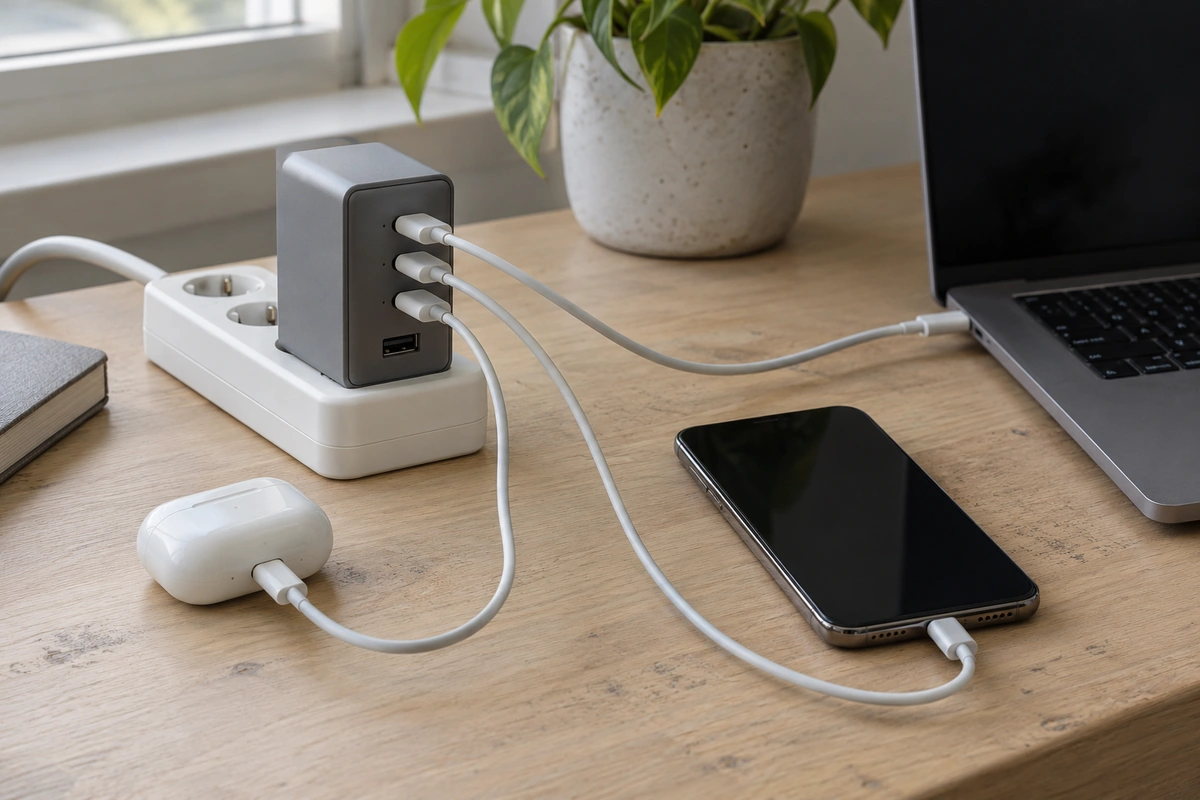
Phone Charger Standby Power: Read Measurements and Estimate Energy
An unloaded charger left in the wall wastes electricity for as long as it stays plugged in. This worksheet keeps your meter reading, your hours, and your tariff separate from published averages.
An unloaded phone charger left in the wall wastes electricity for as long as it stays plugged in. Record that charger’s no-load input power on a plug-in monitor, then calculate annual energy from the reading and your tariff.
No-load means the charger is in the outlet and nothing is attached to its port. Input power is the watts the wall supplies in that state. Anker’s Canada article dated 21 August 2025 states that a charger with no phone connected still draws electricity, and it states a typical standby range of 0.1 to 0.5 watts for a single charger. That range is Anker’s general statement. Your model’s cell stays blank until a meter fills it. The Department of Energy page retrieved 11 October 2026 names the conservation standard at 10 CFR 430.32(w) and the test procedure at 10 CFR 430, Subpart B, Appendix Z. The watt limit is blank here because that saved page names the citations and leaves the watt tables in the Code of Federal Regulations. Household shares of 5 to 10 percent in the sources below add many device types together. Annual energy on this page is your watts times your hours, divided by 1,000, then multiplied by your price per kilowatt-hour.
Scroll horizontally to see all columns if needed.
| Field | What you enter | What the saved pages supply |
|---|---|---|
| Model printed on the charger | ________ | Blank |
| Date of the reading, and the supply voltage you record | ________ | Blank |
| No-load input power, watts, with the port empty | ________ | Anker states 0.1 to 0.5 W as typical. That is not your row. |
| Input power with a phone attached and idle or full | ________ | Blank |
| Meter model, and resolution from its documentation | ________ | Blank |
| Hours the charger stays plugged in during the year | ________ | 8,760 only when you choose every hour of a 365-day year |
| Your price per kWh | ________ | Anker states $0.17 in a Canada household example. That is not your tariff. |
| Annual kWh | watts times hours, divided by 1,000 | Formula |
| Annual cost | annual kWh times your price | Formula |
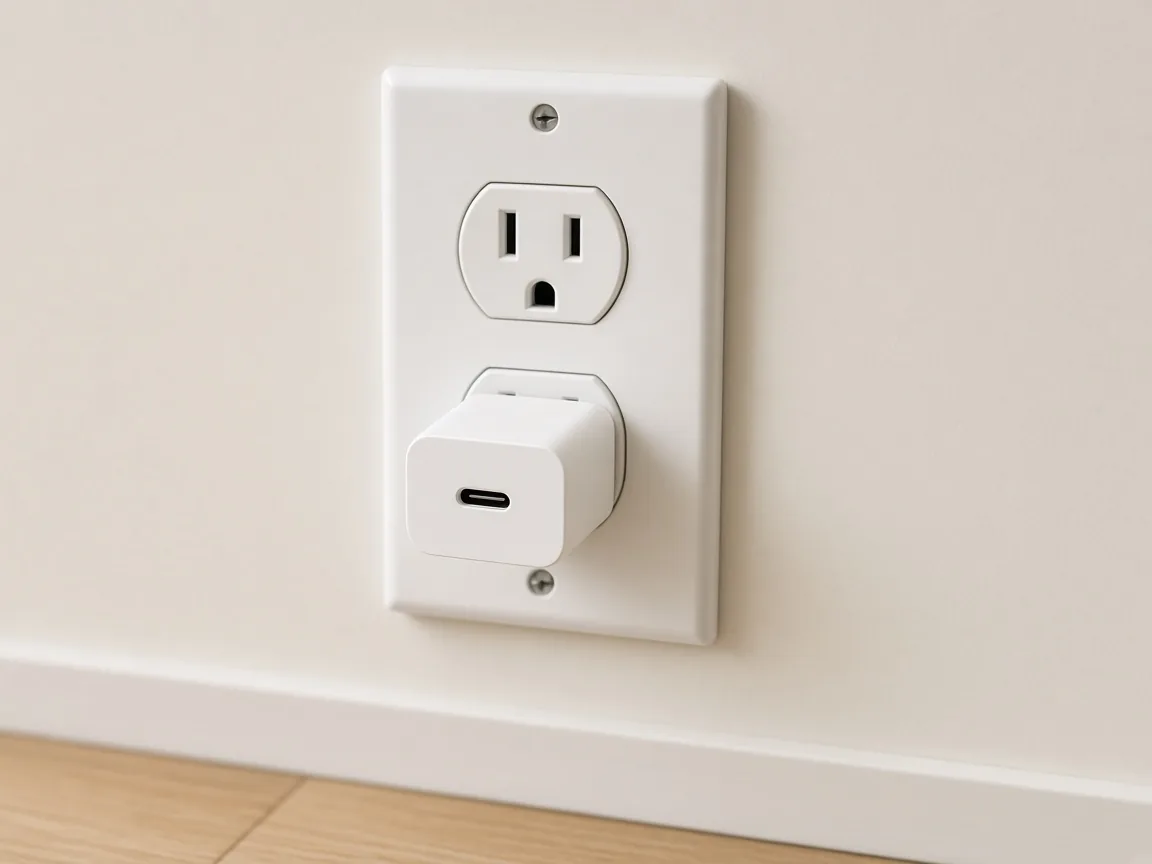
A white charger sits in the lower socket of a wall outlet, and its USB-C port is empty.
What does no-load mean for a phone charger?
No-load is the empty-port condition. The charger is in the wall, and no phone, cable, or other device is attached. Anker’s 21 August 2025 article calls the electricity drawn in that condition standby power or phantom power. The same article describes standby power as energy used by electronics when they are turned off or not in active use, and it says a charger’s transformers and circuit components stay active while the charger remains plugged in. Those two sentences cover different setups: an empty port, and a device that is present but idle. Keep them on separate rows.
The Department of Energy page, retrieved 11 October 2026, quotes the definition in 10 CFR 430.2. An external power supply is an external power supply circuit that converts household electric current into DC current or lower-voltage AC current to operate a consumer product. The quoted definition excludes a commercial and industrial power supply, and a supply designed exclusively for light-emitting diodes that provide illumination, organic light-emitting diodes that provide illumination, or ceiling fans that use direct-current motors. A phone charger is the consumer-product case only when it matches that definition. This page does not sort a particular model into the excluded classes.
The same DOE page says manufacturers have been required to comply with DOE energy conservation standards for external power supplies since 2007. Its current-standard section says external power supplies manufactured and distributed in commerce, as defined by 42 U.S.C. 6291(16), must meet the standards at 10 CFR 430.32(w). Its current-test-procedure section says manufacturers must follow 10 CFR 430, Subpart B, Appendix Z, to determine compliance. The saved page also lists a 16 May 2025 Federal Register notice, 90 FR 20899, proposing to rescind existing energy conservation standards for consumer external power supplies, and a final rule effective 28 May 2026, 91 FR 22703, that removes certain reporting requirements for exempt consumer external power supplies. The watt numbers inside 10 CFR 430.32(w) stay blank on this page. The saved DOE page names the section and does not print them.
The watts printed as an output rating on the charger are a different quantity from no-load input power. The multiport power-sharing guide separates an output ceiling from the power a connected device draws. This page records input power at the wall. PD profiles, cables, and the rest of the setup are on Charging & Power.
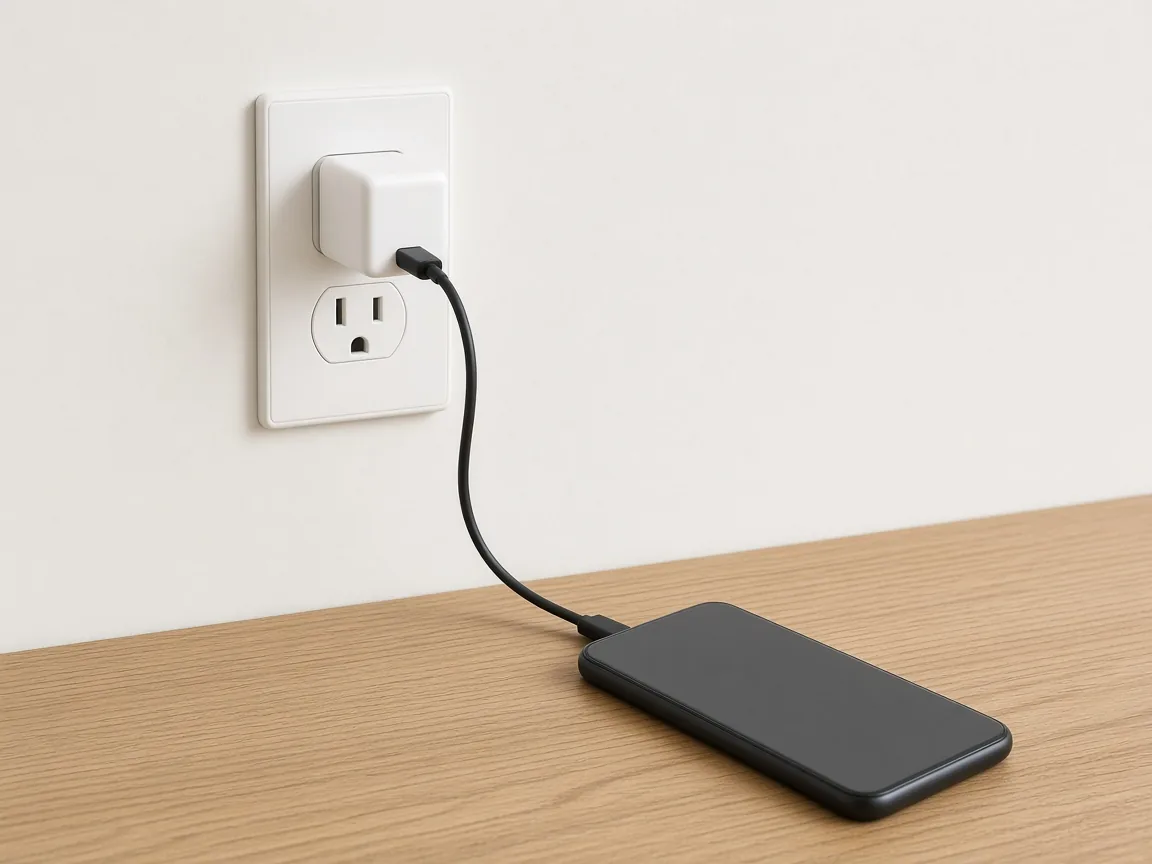
A black cable runs from a white charger in a wall outlet to a black phone lying face down on a wood table.
What figures did the saved pages actually print?
Each figure below stays tied to the page that printed it, the date the copy was saved, and the group of devices that page was talking about. A household percentage is not a phone-charger watt reading.
Scroll horizontally to see all columns if needed.
| Source and date on the page | Saved | Statement in the saved copy | Scope | Figure | Underlying study or watt table in the saved copy |
|---|---|---|---|---|---|
| U.S. Department of Energy, External Power Supplies | 11 October 2026 | Covered external power supplies must meet 10 CFR 430.32(w). Compliance testing follows Appendix Z of 10 CFR 430, Subpart B. | External power supplies as defined on that page | Watt limit: blank | The CFR watt tables are not in the saved page |
| Anker, Richard Nie, 21 August 2025 | 11 October 2026 | A charger with no device connected still draws electricity. A single charger’s standby consumption is typically 0.1 to 0.5 watts. The article puts a single idle charger under $1 per year. The FAQ on the same page says standby for a single charger is typically less than 0.5 watts. | Chargers in general, in a Canada-market article | 0.1 to 0.5 W; under $1 per year; FAQ line less than 0.5 W | Meter model, voltage, sample size, and test date: blank |
| Anker, attributing Natural Resources Canada, in the same 21 August 2025 article | 11 October 2026 | Standby power accounts for 5 to 10 percent of a typical home’s electricity use, or about 150 to 200 kilowatt-hours a year. At an average price of $0.17 per kWh, that equals roughly $25 to $35 a year. | Chargers, TVs, routers, microwaves, and coffee makers together | 5 to 10 percent; 150 to 200 kWh; $0.17/kWh; $25 to $35 | The Natural Resources Canada page is not among the saved copies |
| Save on Energy, phantom-power page | 11 October 2026 | Phantom power, also called standby power, is energy used when devices are plugged in and you are not actively using them. Phantom power can add up to 10 percent of a home’s energy costs. The page states that 75 percent of the electricity these devices consume is used when they are not on. | Household devices. The examples are laptops, gaming consoles, TVs, kitchen appliances, alarm clocks, and electric toothbrushes. | 10 percent of energy costs; 75 percent of those devices’ electricity | Study name: blank |
| David Suzuki Foundation, phantom-energy page | 11 October 2026 | Phantom energy is electricity consumed when devices are turned off, idle, or in sleep mode. Device chargers are on the list of common phantoms. Studies estimate up to 10 percent of total household electricity. The average home in Canada has more than 25 electronic devices drawing phantom power at once. Home electronics are estimated to be on standby 75 percent of the time, totaling 6,500 hours a year. | Household electronics, with Canada named for the device count | Up to 10 percent; more than 25 devices; 6,500 hours | Study name: blank |
Dividing 150 to 200 kWh by a count of chargers would invent a per-charger share. Anker’s sentence lists chargers together with TVs, routers, microwaves, and coffee makers, and the saved article gives no split. The 6,500 hours on the Suzuki page are that page’s household standby-time estimate, equal to 75 percent of the year in their wording. They are not the hours your charger spends in the outlet, and they are not a watt figure.
Save on Energy says an electricity usage monitor lets you plug in a device and check how much power it uses in standby. The Suzuki page says some meters plug into the wall outlet used by a device and show energy while it is running and while it is idle. Both pages also name unplugging devices you are not using. The Suzuki list includes device chargers among the items for which unplugging is effective. That step removes the charger from the supply. It does not produce the watts, the hours, or the price for the formula below.
How do you calculate annual energy from one reading?
Annual energy in kilowatt-hours equals input real power in watts, times hours plugged in, divided by 1,000. Annual cost equals that kilowatt-hour result times your price per kilowatt-hour. Use the no-load watts when the question is the empty port. Use the attached-phone watts, on their own row, when the question is a connected idle or full phone. Add the two only after you have both readings and you know the hours that belong to each state.
The arithmetic below uses Anker’s stated range, Anker’s stated price, and 8,760 hours. 8,760 is 24 times 365, the hour count for a charger left plugged in every hour of a 365-day year. A 366-day year has 8,784 hours. Substitute that hour count only when the charger is actually in the outlet for all of them. This block is arithmetic on published inputs. It is not a measurement, and it is not your bill.
Scroll horizontally to see all columns if needed.
| Input | Value in this block | Origin |
|---|---|---|
| Power, low end | 0.1 W | Low end of the range Anker states as typical |
| Power, high end | 0.5 W | High end of the same Anker range |
| Hours | 8,760 | 24 times 365 |
| Price | $0.17 per kWh | The average Anker states beside the Natural Resources Canada attribution |
0.1 times 8,760, divided by 1,000, equals 0.876 kWh. 0.876 times 0.17 equals 0.14892 dollars.
0.5 times 8,760, divided by 1,000, equals 4.38 kWh. 4.38 times 0.17 equals 0.7446 dollars.
Both dollar results sit under $1 at the price Anker stated, which is the bound Anker’s article gives for a single idle charger. The $25 to $35 figure in that article is the 150 to 200 kWh household total at the same stated price, across the device types Anker listed. Replace 0.1 W or 0.5 W with your meter reading, and replace $0.17 with the price on your bill, before you treat either dollar line as your cost.
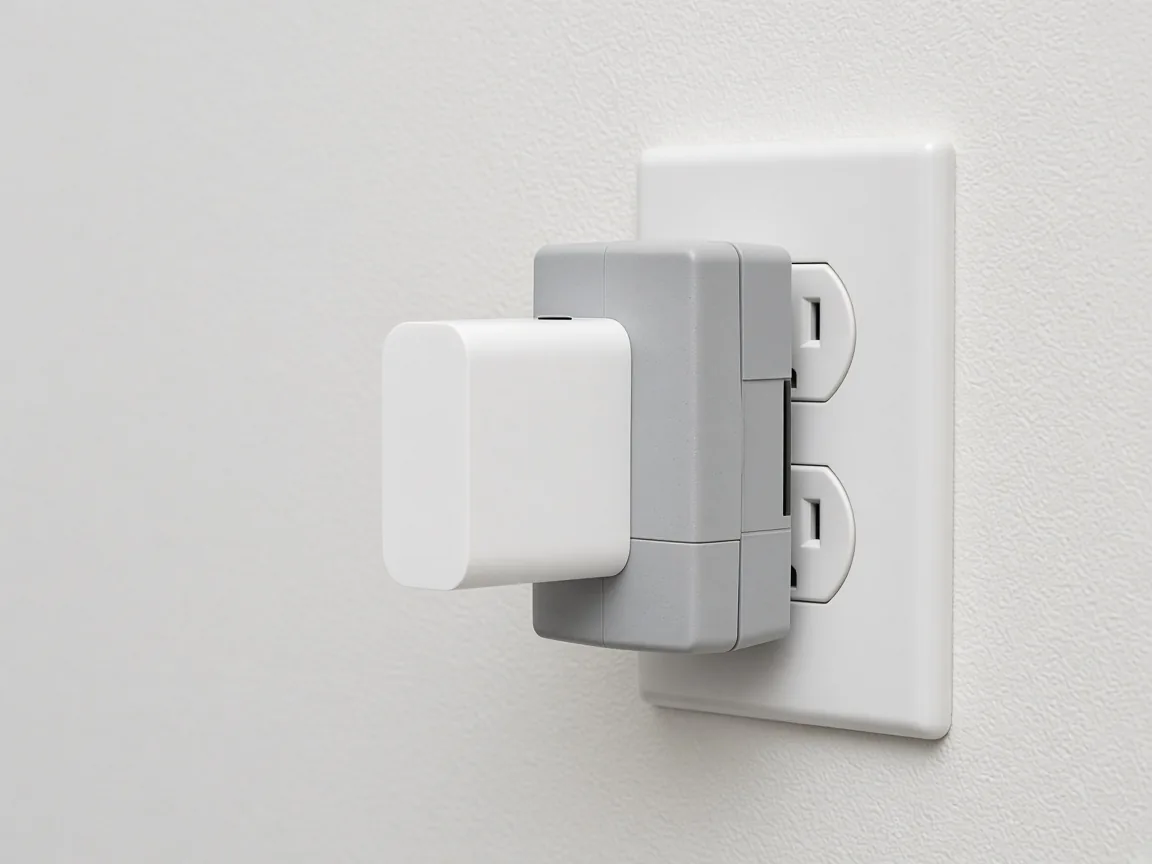
A white charger is plugged into a gray monitor, and the monitor is plugged into a wall outlet with its display facing away.
What do you record when the meter shows zero?
Write the digit the meter showed, the meter model, and the resolution printed in the meter’s documentation. The resolution cell on this page stays blank. None of the four saved pages states a resolution, an uncertainty, or a minimum watt a plug-in monitor can display.
A displayed zero is the result you saw on that instrument. It is a different kind of number from Anker’s 0.1 to 0.5 watt statement, and a different kind of number from the watt limit in 10 CFR 430.32(w), which remains blank here. Copy the zero into the no-load row if that is what the empty-port test showed. Copy a second reading into the attached-phone row when you repeat the test with the phone connected. Leave the resolution field empty until the meter’s own sheet states it.
Which fields stay blank?
Standby current, in amps or milliamps, is blank. None of the four saved pages states a charger standby current, so this page does not convert watts into current.
A numeric no-load limit is blank. The DOE page points to 10 CFR 430.32(w) and to Appendix Z, and the saved copy does not contain those tables.
A U.S. residential price per kWh is blank. The only price in the saved copies is Anker’s $0.17 per kWh, attached to the Canada household example.
A reading from this site is absent. The photographs show an empty port, a phone lying face down on a cable, and a monitor with its display turned away. They do not show a watt value.
Heat, damage, and fire outcome are blank. Energy figures in the saved pages are consumption statements. They are not a damage result, and this page does not infer one.
Any charger model other than the one in your hand stays off the worksheet. Anker’s 0.1 to 0.5 watt range names no model.
How this page was compiled
The four pages were fetched on 11 October 2026 and read again from those saved copies. Anker’s article carries the date 21 August 2025 and the byline Richard Nie, on Anker’s Canada site. The DOE, Save on Energy, and Suzuki copies do not show a publication date in the text that was saved, so the date beside those rows is the retrieval date. The DOE page’s own citations include 16 May 2025 for the proposed standards rescission and 28 April 2026 for the exempt-reporting final rule, with an effective date of 28 May 2026.
The 0.876 kWh, 4.38 kWh, 0.14892 dollar, and 0.7446 dollar lines are products of the inputs in the arithmetic table. Household percentages stay in the source table with their device lists. Your model, your voltage, your two power readings, your meter resolution, your hours, and your price remain blank until you write them in.
How this guide was prepared
Desk research with AI assistance. Figures are copied from four public pages saved on 11 October 2026: the U.S. Department of Energy external-power-supply page, Anker's 21 August 2025 Canada article, Save on Energy's phantom-power page, and a David Suzuki Foundation page. The annual-energy arithmetic uses only those stated inputs plus a 24 times 365 hour count, and it is not a measurement of any charger. Blank cells are items those pages do not state.
Sources and further reading
- External Power Supplies — U.S. Department of Energy. Accessed .
- Do Chargers Plugged In Use Electricity? Learn Cost & Savings Tips — Anker. Accessed .
- Identifying and tracking Your Home's Phantom Power — Save on Energy. Accessed .
- Phantom energy: what it is and how to avoid it — David Suzuki Foundation. Accessed .
Found an error? See our corrections policy and research methodology.