MagSafe Power Bank: Real Usable Capacity and Heat Loss
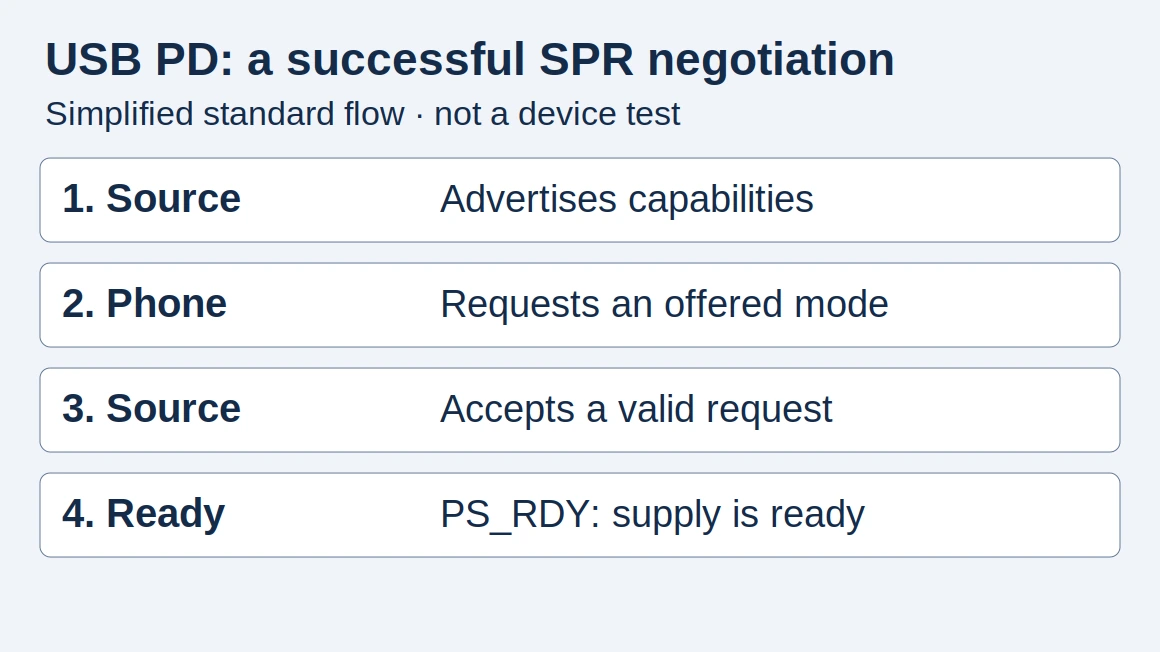
A MagSafe power bank’s label describes stored energy at a specified voltage. Delivered energy and phone battery gain need their own conditions and evidence.
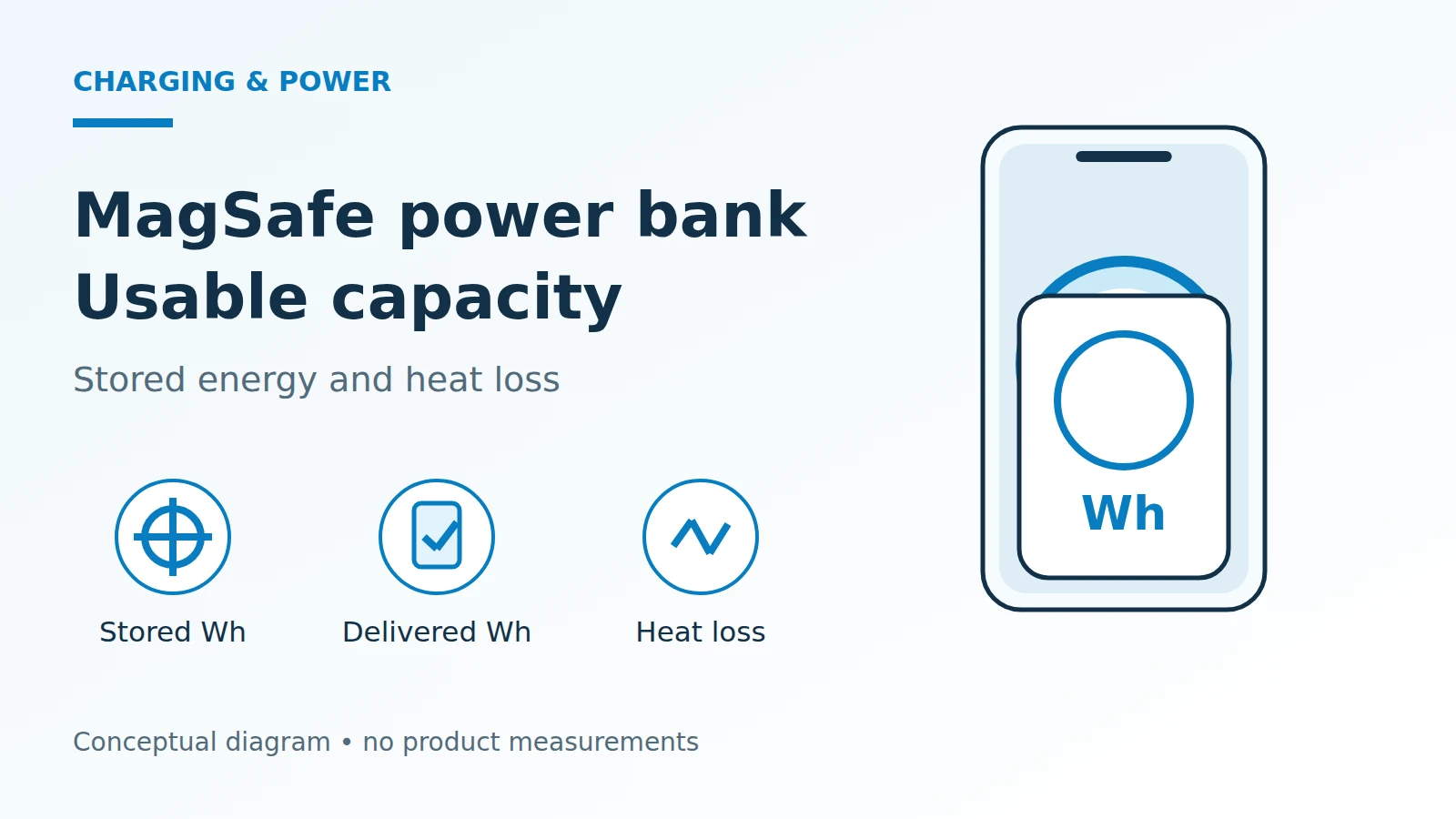
A large capacity label can overstate the top-up you expect on a busy day. To judge a MagSafe power bank’s real usable capacity and heat loss, separate nominal stored energy, energy delivered to the phone and energy actually added to its battery.
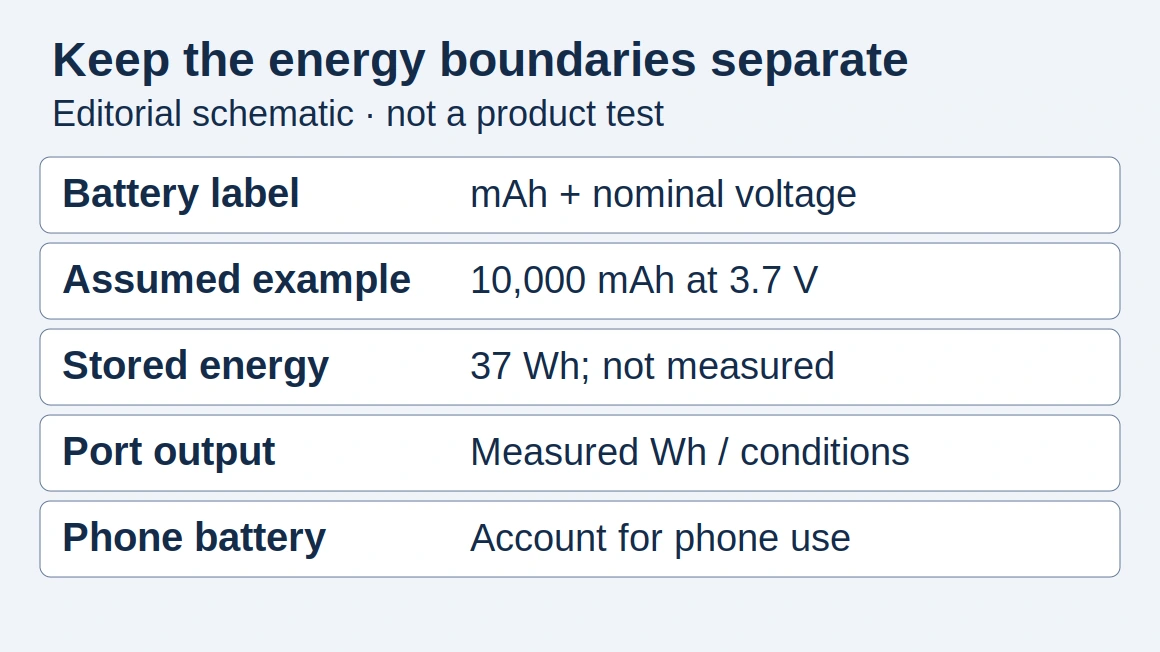
A MagSafe power bank’s mAh label cannot establish delivered Wh or a reliable number of phone charges by itself. Convert its label to nominal Wh using the specified battery voltage, then look for an output-energy result with the phone, charging mode and conditions named. Phone activity and charging losses affect battery gain at different points in the energy path. A warm case or a rise in battery percentage supplies neither a measured heat-loss figure nor a conversion-efficiency percentage. Define which energy boundary “usable capacity” refers to before comparing products.
Where does the energy go?
Nominal stored energy is a label-based reference. Delivered energy crosses a specified output boundary. Net battery gain is what remains stored in the phone after its operation and downstream charging losses are accounted for.
For a wireless comparison, name whether “delivered” means energy reaching the phone receiver or energy entering its battery. A USB meter connected to a bank’s cable output measures a different path. A meter on the bank’s recharge input includes the recharge process; its reading does not directly establish wireless output capacity.
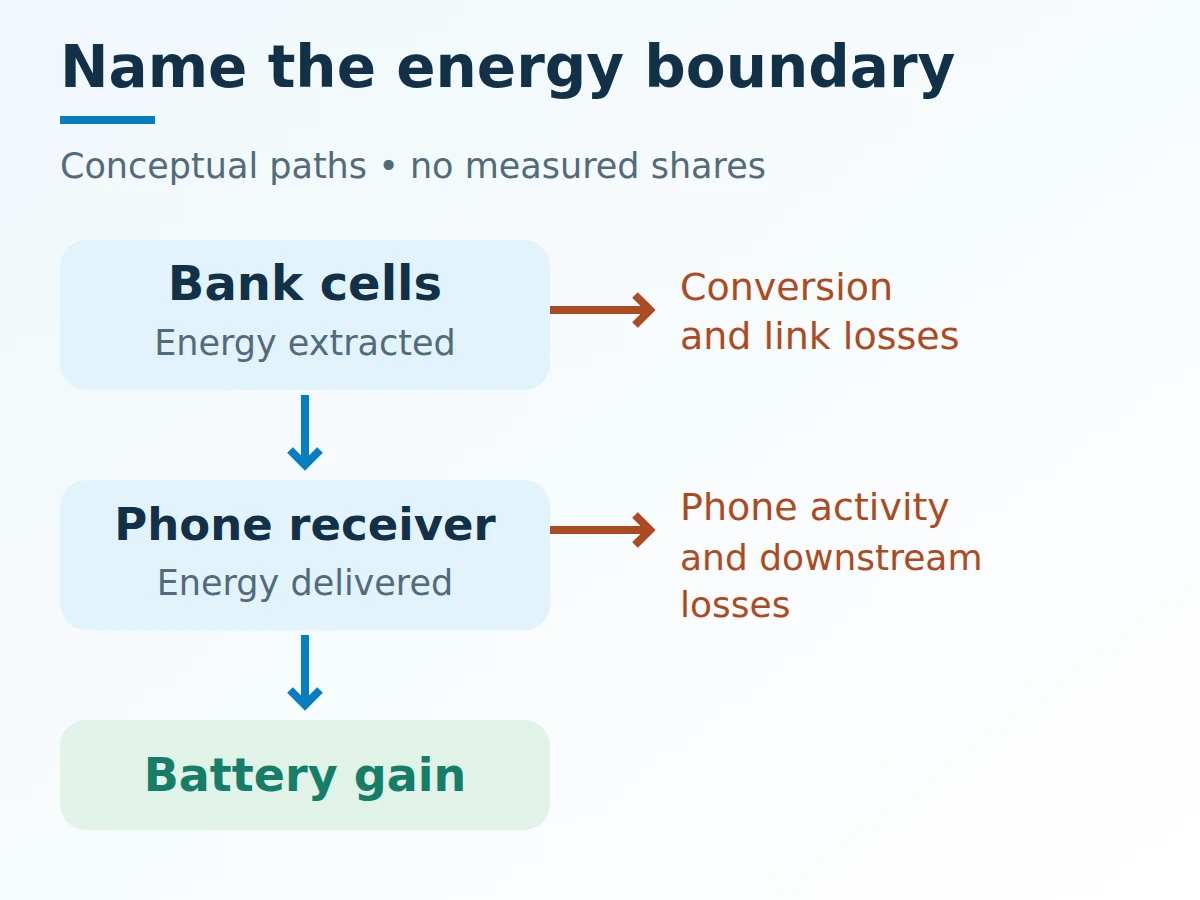
The branches explain the accounting boundaries. Their widths do not represent measured energy shares.
Scroll horizontally to see all columns if needed.
| Capacity statement | Evidence needed | Dominant Failure Mode & Prevention |
|---|---|---|
| Nominal stored energy | Capacity and its nominal battery voltage, or labeled Wh | Treating cell mAh as phone output → convert to Wh and keep the boundary named |
| Wired delivered energy | Measured output Wh, port, load, cable and cutoffs | Applying a wired result to wireless use → retain separate mode records |
| Wireless delivered energy | Defined receiver or battery boundary, method, phone, case and conditions | Comparing unlike measurement points → match boundaries before comparing numbers |
| Phone battery gain | Start/end state, phone model, battery condition and activity | Calling every missing Wh heat → distinguish device use, losses and unused bank energy |
Convert the label before comparing capacity
Use the voltage belonging to the stated capacity. The FAA’s battery guidance gives the underlying relationship: multiply battery voltage by amp-hours to obtain watt-hours.
Formula: nominal stored energy (Wh) = label capacity (mAh) ÷ 1,000 × nominal battery voltage (V).
Assumed worked line: 5,000 mAh ÷ 1,000 × 3.7 V = 18.5 Wh nominal. These hypothetical label inputs describe stored energy only. They do not establish that 18.5 Wh reaches the phone. If the manufacturer’s stated Wh differs from a rounded calculation, check the voltage basis and label documentation.
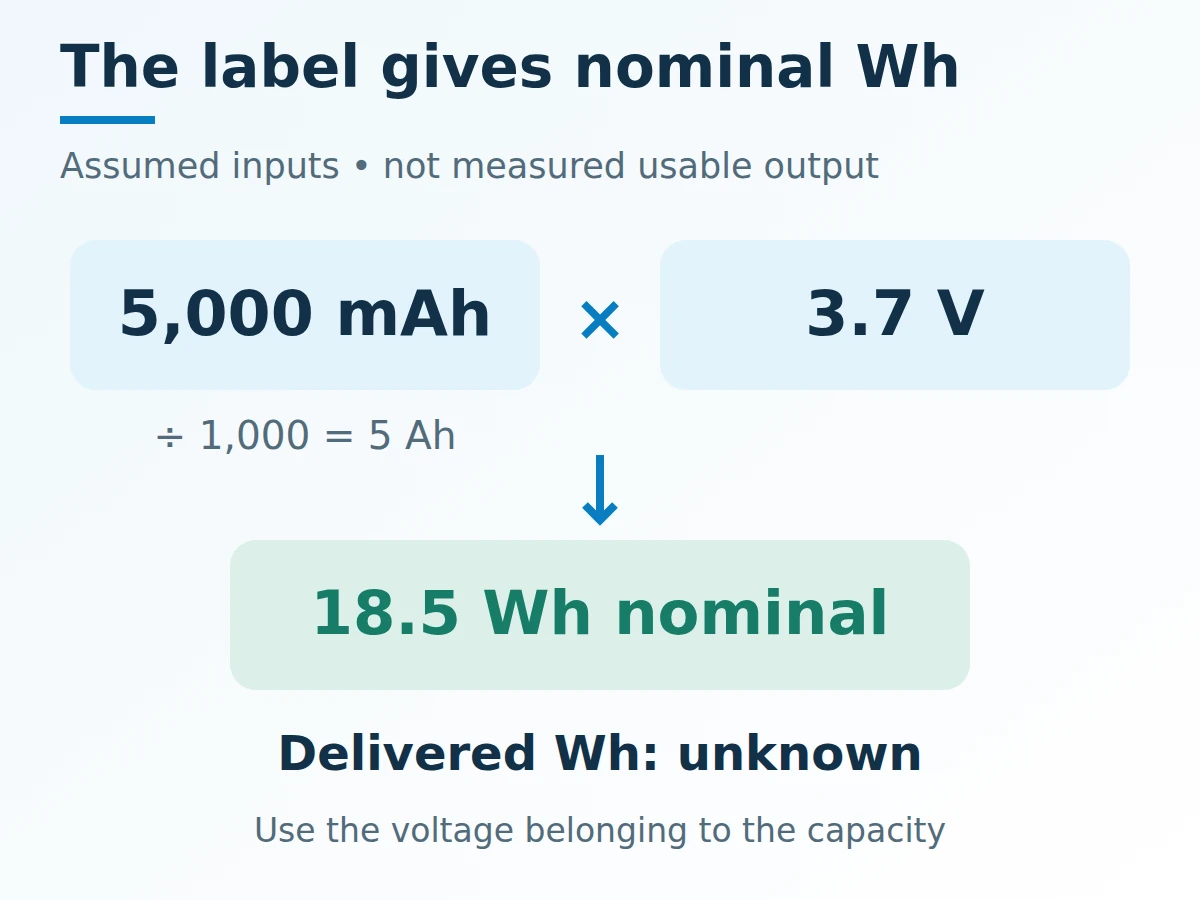
The calculated nominal figure ends at the bank’s stored-energy boundary.
A “5,000 mAh” bank and a “5,000 mAh” phone cannot be compared as equal energies until their voltage bases are known. For the broader capacity and output record, use the power-bank guide.
Read additional-charge claims as model-specific results
A claim about percentage added to a phone describes that phone under a particular procedure. It is not the percentage of bank energy converted into stored phone energy.
Apple’s MagSafe Battery Pack specifications illustrate the distinction: the additional-charge claims vary by named iPhone group. Apple’s footnote describes preproduction devices and software, screen-locked testing, network connections and selected settings. Carry those conditions with the claim. They do not establish results for a different bank, current phone or screen-on navigation session.
Also separate portable discharge from operation while attached to an external supply. Apple’s archived instructions for its Lightning-equipped MagSafe Battery Pack describe those as different operating conditions. Identify the actual model before applying its instructions; the historical Apple accessory is one product, not a specification for all magnetic banks.
Apply a thermal rule without guessing heat loss
Rule of thumb for an iPhone: if ambient temperature is above 35°C, relocate the charging session before comparing usable capacity. Apple’s temperature guidance specifies an ambient operating range of 0–35°C and explains that internal temperature protection can slow or stop charging. This is an ambient condition, not a measured surface-temperature cutoff.
For the historical Apple MagSafe Battery Pack specifically, its archived support instructions say software may limit charging above 80% if the battery gets too warm. Moving to a cooler location is the suggested response. That conditional behavior does not define a universal stop point for third-party banks.
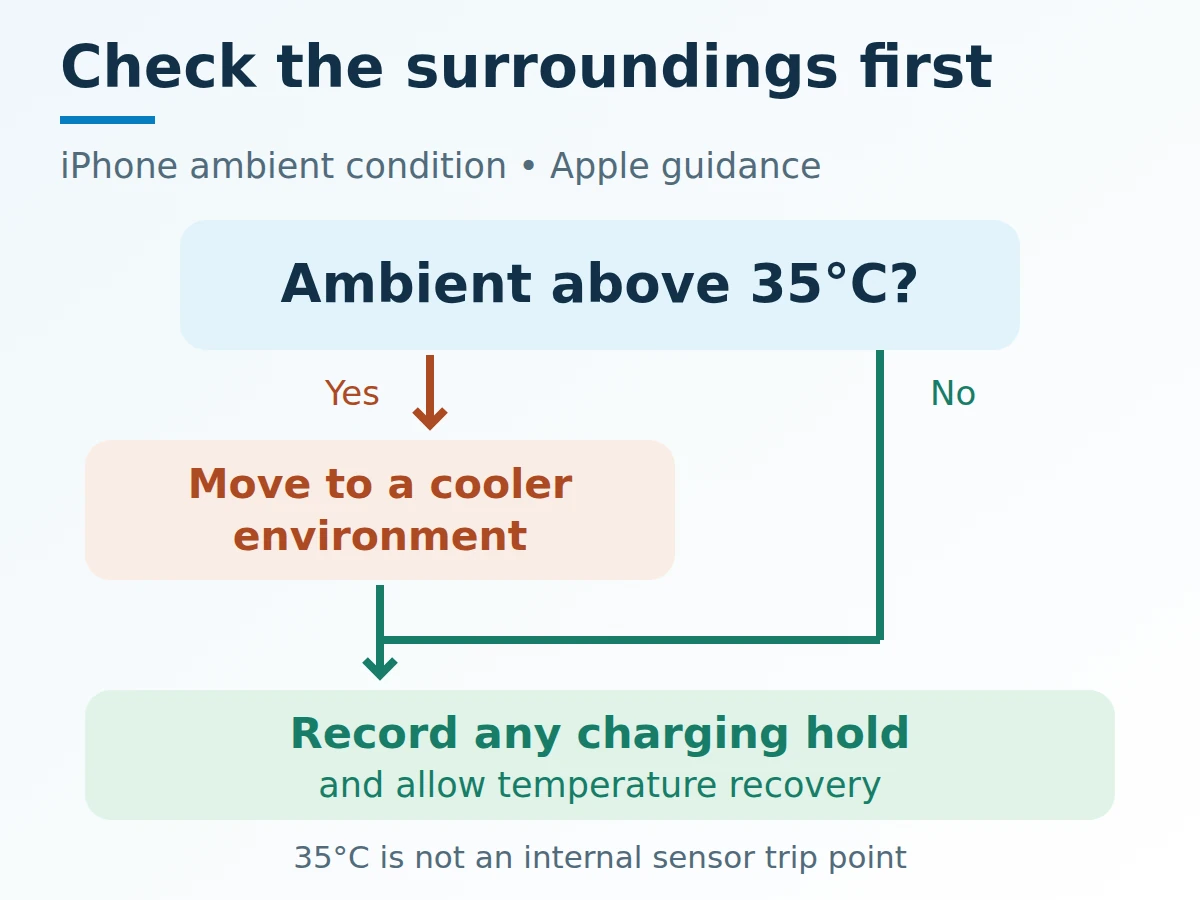
Keep the environment check separate from the phone’s internal thermal controls.
Heat is an energy-transfer outcome, while temperature is a state. Estimating heat from a surface-temperature reading would require additional thermal measurements and a defensible model. For a practical comparison, log the charging hold, surroundings, case, phone activity and elapsed time. Do not turn warmth into an assumed loss percentage.
Keep an energy and time ledger
Choose the measurement boundary first and leave unavailable energy fields unknown. The accounting identity is energy extracted from the bank = energy delivered at the chosen boundary + losses before that boundary. Nominal label energy is not a measurement of extracted energy; residual charge and discharge cutoffs also matter.
Scroll horizontally to see all columns if needed.
| Ledger entry | Your record | Decision it supports |
|---|---|---|
| Bank label | mAh, corresponding voltage, Wh, model | Compare nominal stored energy using the capacity checklist |
| Session mode | Wireless or wired; external supply connected or absent | Keep portable discharge separate from powered operation |
| Delivered energy | Wh, boundary, method and start/end cutoffs; otherwise unknown | Compare usable output only under matched conditions |
| Phone state | Model, software, battery condition, start/end percentage, screen and workload | Interpret observed top-up without claiming calibrated Wh |
| Thermal interruptions | Ambient conditions, charging message and paused duration | Account for lost charging opportunity |
| Recharge overhead | Elapsed recharge time and input Wh if measured | Assess daily readiness; check adapter profiles with the USB PD explanation |
If the available evidence stops at the label, report nominal capacity and an observed top-up separately. Use the charging and power guide to complete the adapter and cable record before choosing a portable setup.
Method and sources
Primary references were accessed October 19, 2026. The label calculation uses stated assumptions; the ledger is a proposed comparison record. Apple’s historical accessory guidance remains identified as archived. No generic wireless conversion rate, measured heat-loss value or charge-count guarantee is assigned. Updated October 2026.
How this guide was prepared
Desk research using the linked primary sources, with AI assistance. Diagrams explain technical relationships; numerical examples use stated assumptions and do not report product measurements.
Sources and further reading
- PackSafe: Lithium Batteries (Wh calculation) — Federal Aviation Administration. Accessed .
- How to use your MagSafe Battery Pack (archived) — Apple. Accessed .
- MagSafe Battery Pack technical specifications and test conditions — Apple. Accessed .
- If your iPhone or iPad gets too hot or too cold — Apple. Accessed .
Found an error? See our corrections policy and research methodology.