Power Banks: Capacity, Output and Compatibility
Compare stored energy and usable port output separately. A capacity label alone does not establish how many times a particular phone will charge.
Capacity and charging power answer different questions
Milliamp-hours describe charge capacity at a specified voltage. Watts describe power. Watt-hours describe energy. Keeping these units separate makes product comparisons clearer.
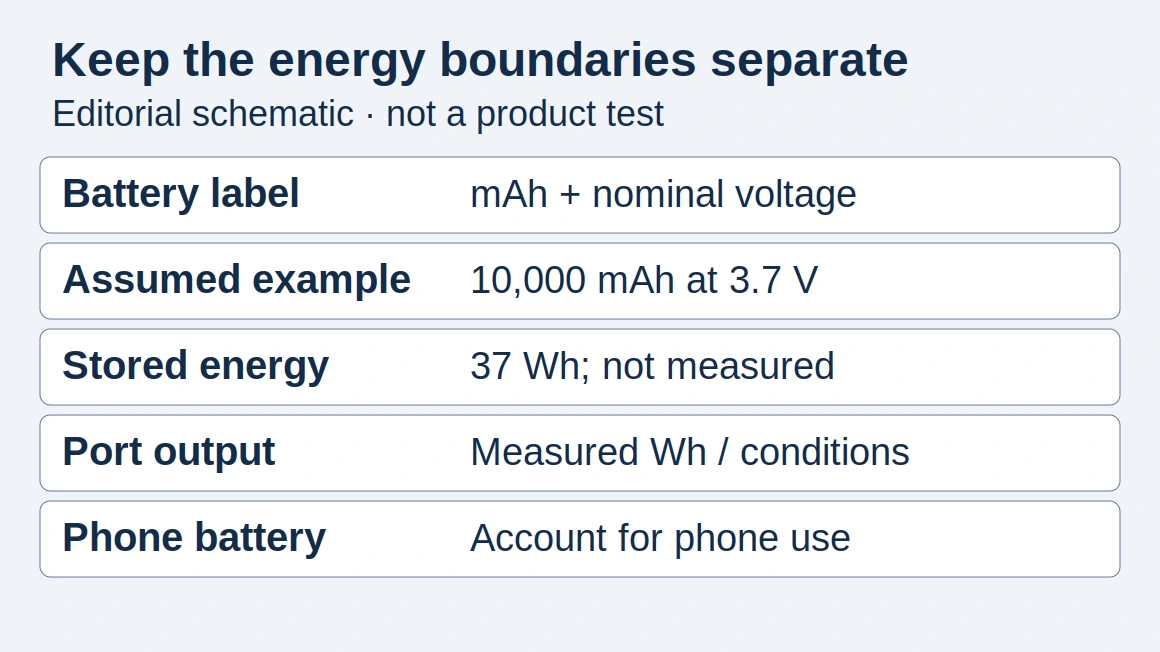
The FAA’s public battery guidance gives Wh = V × Ah. Copy this energy record; the example inputs are assumed, not a measured power bank.
Scroll horizontally to see all columns if needed.
| Energy field | Your product | Assumed arithmetic example |
|---|---|---|
| Label capacity, mAh | ___ | 10,000 mAh |
| Capacity’s nominal voltage, V | ___ | 3.7 V |
| Nominal energy, Wh | ___ | 10,000 ÷ 1,000 × 3.7 = 37 Wh |
| Measured output energy, Wh | ___ | Not measured |
| Port / load / cable / start-end state / temperature | ___ | No test performed |
Stored nominal energy, energy delivered at the port and energy stored in the phone are different boundaries. Record output-test conditions separately; the phone also consumes energy during charging.
Avoid a false “number of charges”
Dividing a bank’s mAh rating by a phone’s mAh rating can be misleading when the voltage basis and losses are not accounted for. Prefer documented output-capacity measurements with the test conditions stated. Treat a seller’s charge-count claim as incomplete unless it names the phone and method. No loss percentage or charge-count estimate is assumed here.
Compare the practical setup
Scroll horizontally to see all columns if needed.
| Field | What to write down |
|---|---|
| Stored energy | Wh on the label, with the capacity voltage |
| Phone output | Port, maximum output and supported modes |
| Bank recharge input | Required adapter and advertised input |
| Cable | Included or separately required |
| Port sharing | Allocation with all intended devices connected |
| Size and mass | Whether it fits the intended daily use |
USB-C sockets may serve different roles. Check the manufacturer’s port description rather than assuming every socket offers the same input and output capabilities. Simultaneous charging from one outlet is a separate record from capacity and port output. Use the pass-through model matrix and the maker’s document for that exact model.
Match the charging mode
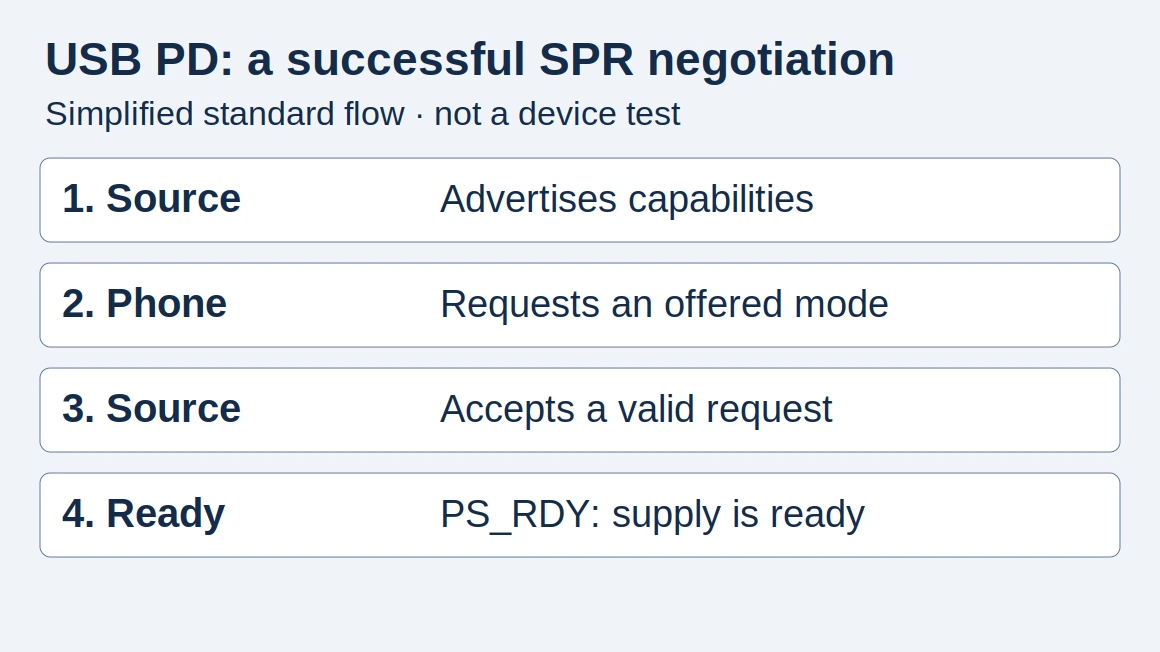
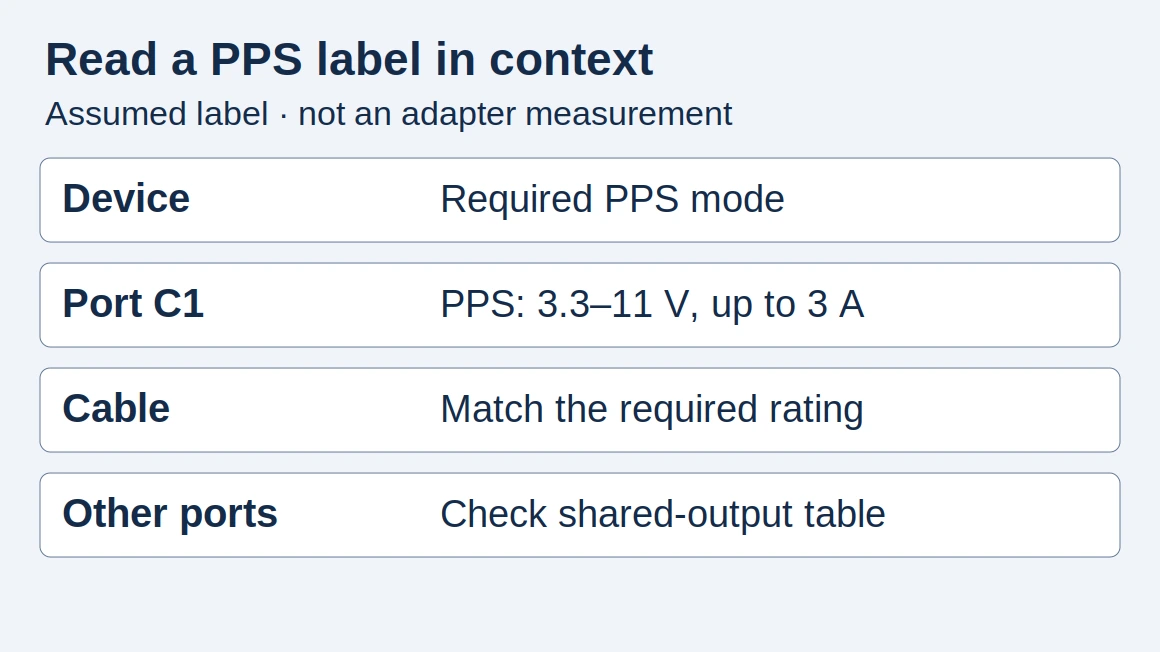
Use our USB PD explanation to interpret power-source specifications. Where your phone requires PPS, verify it explicitly with the PPS checklist.
Travel needs a separate current check
This guide does not establish airline or shipping eligibility. Before travel, consult your airline’s current rules using the exact product’s energy label and condition. Keep damaged or recalled products out of use and follow the manufacturer’s instructions for handling them.
How this guide was prepared
Desk research using the linked primary sources, with AI assistance. Purchasing workflows and numerical examples are editorial illustrations, not product tests or supplier inspections.
Sources and further reading
- USB Charger (USB Power Delivery) — USB-IF. Accessed .
- Certified USB Fast Charger initiative — USB-IF. Accessed .
- PackSafe — Lithium Batteries (Wh calculation) — Federal Aviation Administration. Accessed .
Found an error? See our corrections policy and research methodology.