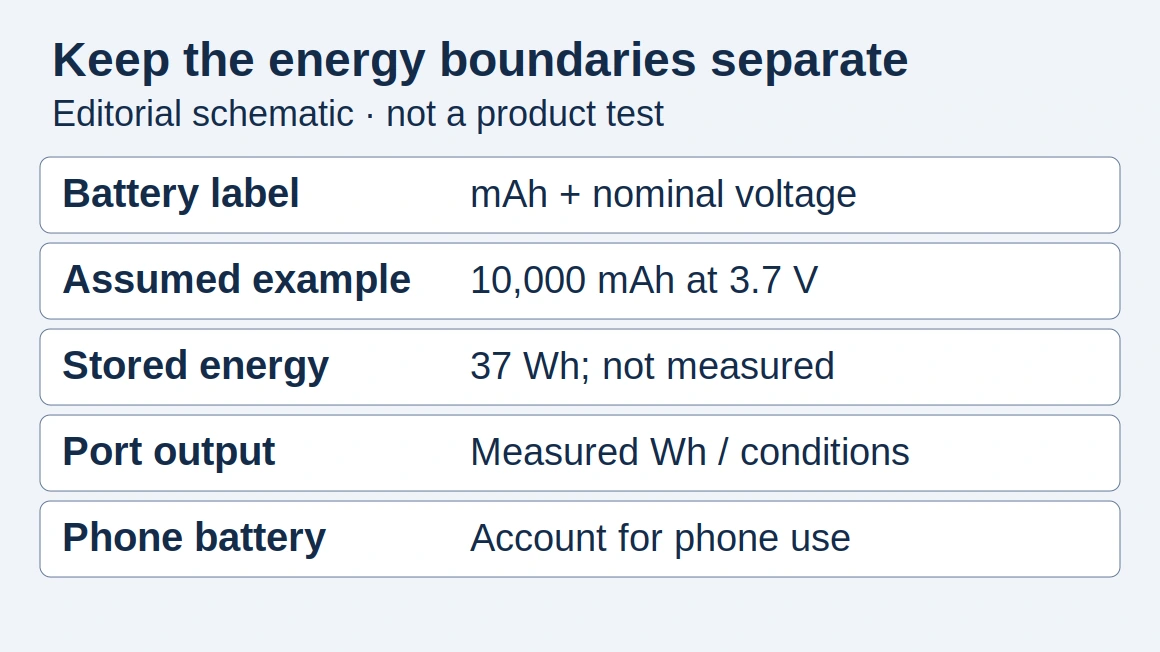
Can You Charge a Pass-Through Power Bank Safely?
Pass-through support is a line in one model's document. This matrix records what Belkin and Anker wrote for named models on 11 October 2026, including input limits, phone paths, and cells the documents leave blank.
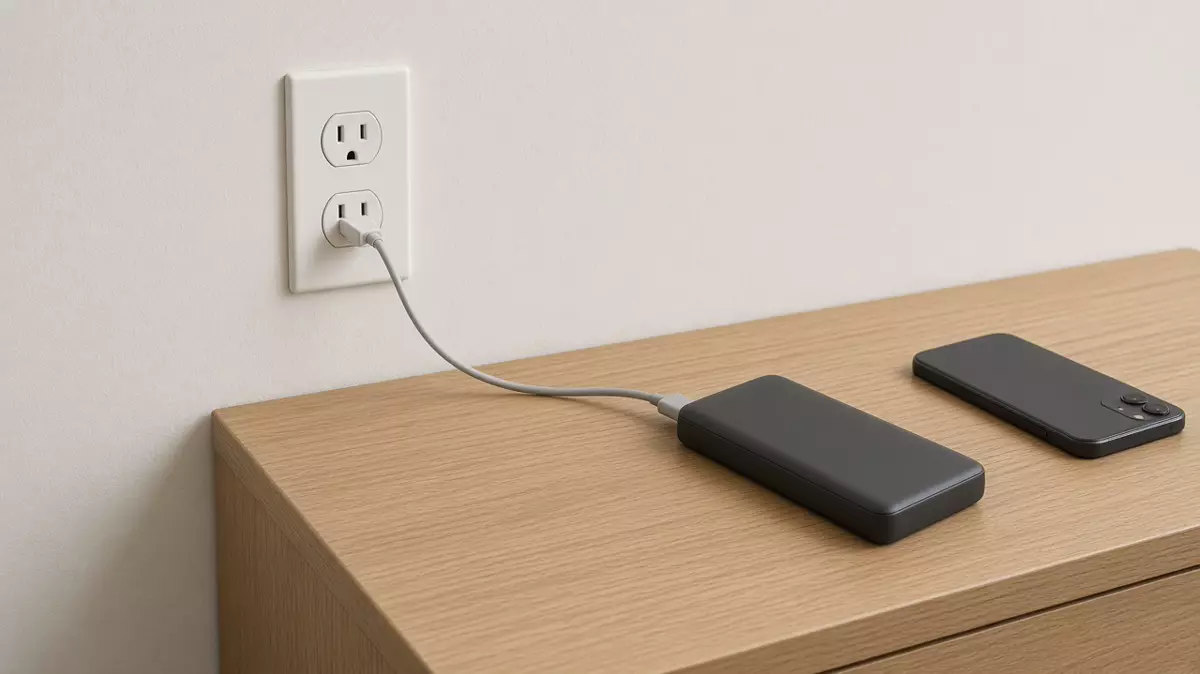
Sharing one outlet between a phone and a power bank fails when that model has no pass-through support. Match the name on the case to the maker’s document before you connect the wall cable and the phone.
In the pages below, pass-through means the power bank has input power connected and a phone receives power during that same connection. The matrix uses support copies retrieved on 11 October 2026. A blank cell means the retrieved document does not state that item. This site does not inspect your unit. Open the maker page for the model in your hand, using the titles under Sources.
Support is a line about one model. Belkin’s 5K/10K FAQ, retrieved 11 October 2026, says those power banks do not support pass-through charging. Belkin’s FAQ for BPD006, BPD007 and BPD008 says those models can recharge and charge a device at the same time, and it lists a pass-through output for each code. Belkin’s Australia page for the UltraCharge Pro Laptop Power Bank 25K (BPB039) says the pack can recharge from a wall charger while wirelessly charging a phone at up to 15 W. Anker’s article for the Power Bank (25K, 165W, Built-In and Retractable Cables) enables pass-through only when input power is 20 W or greater, then sets output by that input band. None of the four pages state that phone power continues without a break.
Scroll horizontally to see all columns if needed.
| Input or item | Documented value | Why it matters |
|---|---|---|
| Model name | The string on the case, matched to one support page | Belkin documents a no for the 5K/10K packs and a yes for BPD006, BPD007 and BPD008 |
| Anker 25K, 165 W input | 20 W or greater to enable pass-through | Below 20 W, Anker says the bank only recharges itself |
| BPD006 and BPD007 phone path in the pass-through block | 15 W Qi2 wireless for iPhone | That block does not list a wired USB-C phone output |
| BPD008 phone path in the pass-through block | 15 W Qi2 wireless for iPhone, or USB-C PD 18 W maximum | This code has two USB-C PD in/out ports |
| BPB039 | Wireless, up to 15 W, while a wall charger is connected | Wired phone output during that connection is blank in the Australia article |
| Uninterrupted output | Blank on all four pages | Phone power through the plug-in moment is unstated |
A white plug in the lower socket of a wall outlet, with the cable seated in a dark power bank on a wood nightstand and a face-down phone beside it.
Can this exact model recharge while it powers a phone?
Only the row that names your model can answer that. A USB-C socket and the brand on the case are separate facts from the support line. Belkin’s 5K/10K FAQ says those packs do not support pass-through charging. The same company’s FAQ for BPD006, BPD007 and BPD008 says yes: the packs charge through the USB-C port and support pass-through charging so you can charge a device and recharge the power bank at the same time. BPB039’s Australia article says yes for wireless charging while the pack is plugged into a wall charger. Anker’s 25K, 165 W article says yes only when input power is 20 W or greater.
The 5K/10K FAQ also answers a different question, “Can I use my device while it is charging with these battery packs?”, with yes. That sentence is about using the phone while the pack charges the phone. The pass-through answer in the same FAQ is the no.
Scroll horizontally to see all columns if needed.
| Model, as named on the support page | Retrieved | Support while input is connected | Input prerequisite | Phone path in that mode | Uninterrupted output | Charge-state note |
|---|---|---|---|---|---|---|
| Belkin BOOST CHARGE Power Banks 5K/10K. The FAQ names F7U045 and F7U046. The page title prints an upward arrow in BOOST CHARGE. | 11 October 2026 | Not supported | Blank. Charging the packs requires an adapter with a USB-A port. | Blank | Blank | Blank |
| Belkin BPD006, BoostCharge Pro Magnetic Power Bank with Qi2 15W | 11 October 2026 | Supported. Pass-through block applies when you copy that heading. | USB-C 20 W maximum, labeled pass-through. USB-C 12 W maximum, labeled power bank recharge. | 15 W Qi2 wireless for iPhone. Wired USB-C output in the pass-through block: blank. One USB-C PD in/out port. | Blank | Belkin gives one 7-to-8-hour window for these three codes. See the note under the table. |
| Belkin BPD007, same family | 11 October 2026 | Supported. Pass-through block applies when you copy that heading. | USB-C PD 20 W maximum, labeled pass-through. USB-C PD 18 W maximum, labeled power bank recharge. | 15 W Qi2 wireless for iPhone. Wired USB-C output in the pass-through block: blank. One USB-C PD in/out port. | Blank | Same 7-to-8-hour window |
| Belkin BPD008, same family | 11 October 2026 | Supported. Pass-through block applies when you copy that heading. | USB-C PD 20 W maximum, labeled pass-through. USB-C PD 18 W maximum, labeled power bank recharge. | 15 W Qi2 wireless for iPhone, or USB-C PD 18 W maximum. Belkin also prints “7.5 wireless output plus 5W maximum USB-C”. Two USB-C PD in/out ports. | Blank | Same 7-to-8-hour window |
| Belkin UltraCharge Pro Laptop Power Bank 25K (BPB039), Australia article | 11 October 2026 | Supported for wireless charging while the pack is connected to a wall charger | Wall charger connected. An input watt ceiling is blank in this article. | Wireless, up to 15 W, for Qi-compatible phones. Wired phone output: blank. | Blank | A percentage display is documented. What it shows during pass-through is blank. |
| Anker Power Bank (25K, 165W, Built-In and Retractable Cables) | 11 October 2026 | Conditional. Enabled at 20 W input or greater. Not activated below 20 W. | Input power 20 W or greater. Below 20 W the bank is only in a self-recharging state. | USB-C1, USB-C2, USB-C3 and USB-A at the output in the band table below. | Blank | Below 20 W: self-recharge only. At 20 W and above, movement of the bank’s own charge indicator is blank. |
Belkin’s time sentence for BPD006, BPD007 and BPD008 says you can charge a mobile phone from empty to full and the power bank from empty to full within 7 to 8 hours. Belkin lists three conditions on that time: the bank’s starting charge, the charger used, and charging a device while the power bank charges.
When the wall cable is connected, copy the block Belkin titles Pass-Through Mode. The block titled Power Bank Mode is a different list, with its own watt lines. A separate port summary on the same FAQ says BPD006, BPD007 and BPD008 are up to 20 W input and 12 W output, and it attributes the 12 W output limit to the battery cell and heat. The pass-through block for BPD008 also lists USB-C PD 18 W maximum. This page keeps those sentences side by side and does not average them.
Any other model code stays off this matrix. A yes on BPD008 does not transfer to another Belkin pack, and the Anker 20 W rule does not transfer to another Anker pack.
What input does the Anker article require?
Anker says this one model, the Power Bank (25K, 165W, Built-In and Retractable Cables), can enable pass-through charging only when input power is 20 W or greater. Below 20 W, pass-through is not activated and the bank is only in a self-recharging state. If output power would exceed input power, Anker says the bank limits output to less than the input power.
The article then prints output by input band. Where a figure spans the USB-C and USB-A columns, the saved table uses one cell across both, so the figure below stays in that combined cell. The source writes its less-than sign as a full-width character. Each band includes its left value and stops before its right value. Input at 100 W or above has no row.
Scroll horizontally to see all columns if needed.
| Input power | Ports in use | Output as printed |
|---|---|---|
| Below 20 W | Not supported | One cell across the port columns: not supported |
| 20 W up to, and short of, 22.5 W | Single port | One cell across USB-C and USB-A: 5 V at 3 A |
| 20 W up to, and short of, 22.5 W | Dual-port or triple-port | One cell across USB-C and USB-A: shared 5 V at 3 A |
| 22.5 W up to, and short of, 30 W | Single port | One cell across USB-C and USB-A: 18 W |
| 22.5 W up to, and short of, 30 W | Dual-port or triple-port | One cell across USB-C and USB-A: shared 5 V at 3 A |
| 30 W up to, and short of, 45 W | Single port | One cell across USB-C and USB-A: 22.5 W |
| 30 W up to, and short of, 45 W | Dual-port or triple-port | One cell across USB-C and USB-A: shared 5 V at 3 A |
| 45 W up to, and short of, 60 W | Single port | USB-C 30 W, USB-A 18 W |
| 45 W up to, and short of, 60 W | Dual-port or triple-port | One cell across USB-C and USB-A: shared 5 V at 4.5 A |
| 60 W up to, and short of, 80 W | Single port | USB-C 45 W, USB-A 18 W |
| 60 W up to, and short of, 80 W | Dual-port or triple-port | One cell across USB-C and USB-A: shared 5 V at 4.5 A |
| 80 W up to, and short of, 100 W | Single port | USB-C 65 W, USB-A 18 W |
| 80 W up to, and short of, 100 W | Dual-port or triple-port | One cell across USB-C and USB-A: shared 5 V at 4.5 A |
Read the band that matches the charger you connect. The 65 W USB-C figure in the 80 W band is Anker’s listed single-port output for that input. The phone’s draw is a separate fact from that listed ceiling.
Which path can reach the phone?
The phone path is whichever output the pass-through block names. On BPD006 and BPD007 the pass-through block names 15 W Qi2 wireless for iPhone, and each model has one USB-C PD in/out port. The wall cable uses that port. A wired phone connection during pass-through is blank for those two codes. On BPD008 the pass-through block names 15 W Qi2 wireless for iPhone or USB-C PD 18 W maximum, and also the “7.5 wireless” plus 5 W USB-C line quoted above. BPD008 has two USB-C PD in/out ports.
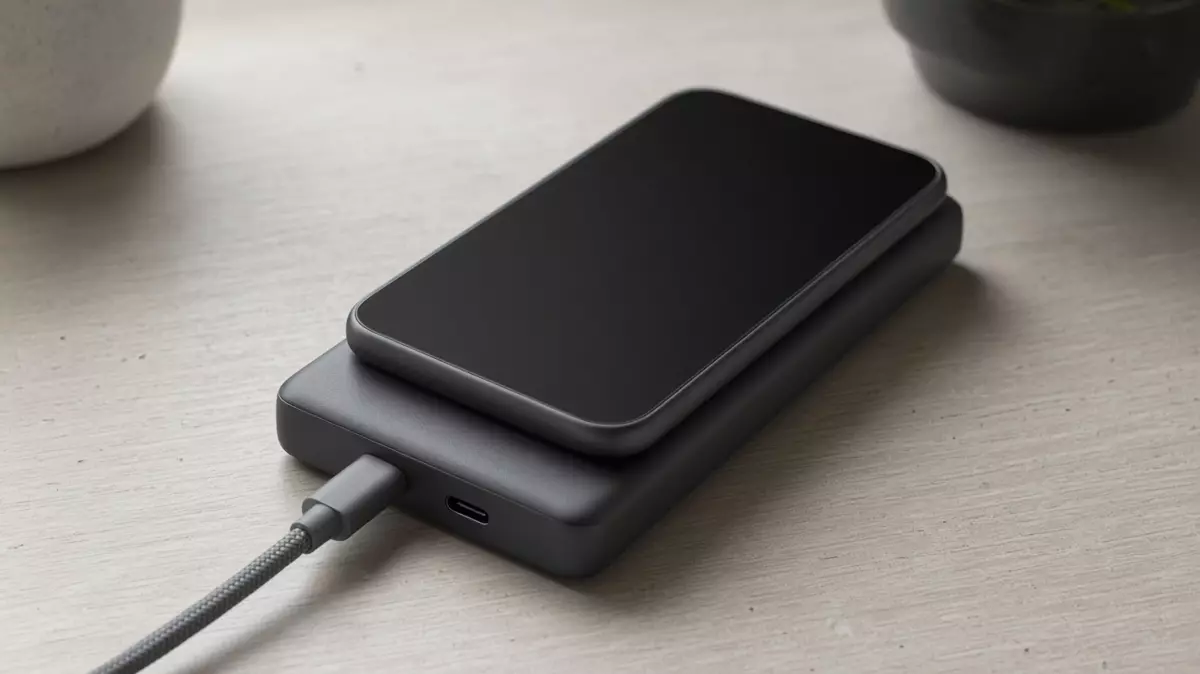
A dark phone with a black screen rests on a dark power bank, with one cable seated in the near port.
BPB039’s article describes wireless charging while the pack is on a wall charger, up to 15 W, for Qi-compatible phones. Belkin says to use that pass-through arrangement for convenience, and says wireless pass-through can be slower than direct wired charging. A wired phone output while the wall charger is connected is blank in that article. Belkin also says to remove a cable after charging finishes, to limit unnecessary power draw.
A separate answer on the BPD FAQ lists these codes at up to 7.5 W wireless, optimized for China (CCC) compliance: BPD006yzBK-APL, BPD006YzPK-APL, BPD006yZSD-APL, BPD006yzBK, BPD006yzWH, BPD006yzBL, BPD009yzBK-APL, BPD008yzBK and BPD008yzWH. Belkin lists phone usage, temperature and alignment as conditions that change wireless charging speed on those codes. That 7.5 W answer is not inside the Pass-Through Mode heading, so this page does not replace the 15 W pass-through line with it. If your case shows one of those codes, copy the 7.5 W answer next to the pass-through line and keep both.
The 5K/10K packs use USB-A. Belkin says F7U045 has one USB-A port at 2.4 A, and F7U046 has two USB-A ports, one at 1.0 A and one at 2.4 A. Charging those packs needs an adapter with a USB-A port. Their pass-through answer remains no. A USB-C pack is a different model and needs its own page.
What did the documents leave blank?
Uninterrupted output is blank on every row. None of the four pages say the phone keeps charging through the moment you plug the bank in, or that the bank carries the phone if the wall power drops.
Heat, cell life and warranty outcome for this setup are blank. The pages do not report a temperature rise, a cycle count, or a damage result for pass-through on these models. The 12 W output note on the BPD port summary is Belkin’s attribution to the cell and heat. It is not a measured temperature.
BPB039’s input watt ceiling is blank. Wired phone output is blank for BPB039, BPD006 and BPD007 in the pass-through blocks. Anker’s table has no row at 100 W or above. Behavior of the bank’s own charge lights during a supported pass-through session is blank, except Anker’s statement that below 20 W the bank is only self-recharging, and Belkin’s 7-to-8-hour window for the three BPD codes.
Circuit layout is blank here as well. These support pages do not describe a power-path schematic, and this page does not add one.
How do you record a model that is not listed?
Copy this row for the unit in your hand. Leave a field empty until the maker’s own page for that exact model states it. A product title that says USB-C, a brand that has one supported model, or a seller’s feature bullet is not a substitute for that page.
Scroll horizontally to see all columns if needed.
| Field | What you write |
|---|---|
| Model string on the case | ________ |
| Support page title, and the date you opened it | ________ |
| Does that page say pass-through is supported? | ________ |
| Input prerequisite, with the watt condition | ________ |
| Phone path allowed while that input is connected | ________ |
| Output limit on that path | ________ |
| Uninterrupted output, if the page states it | ________ |
| What the bank’s charge indicator does during the setup, if the page states it | ________ |
Capacity, watt-hours and ordinary port output are a different record. Keep them on the power bank capacity and output guide.
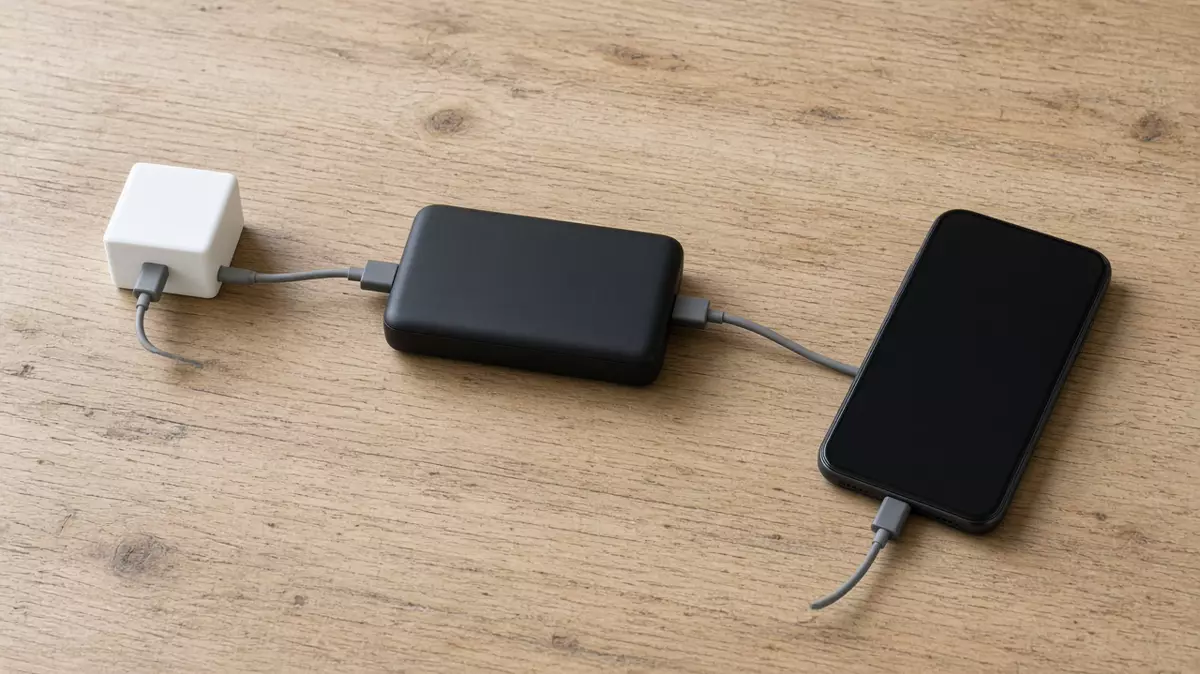
Gray cables join a white cube, a black power bank and a black phone on a wood table.
How this page was compiled
The four support pages were fetched on 11 October 2026 and read again from those saved copies for this article. Belkin’s 5K/10K and BPD articles are on belkin.com. The BPB039 article is on Belkin’s Australia support site, so a reader in the United States still has to match BPB039 to the page that covers the unit they hold. Anker’s band table is from Anker’s support article for the named 25K, 165 W model. The pages do not show a publication date in the text that was saved, so the date on this matrix is the retrieval date.
Figures are copied in the units the maker printed. Where Belkin prints “7.5 wireless” without a unit on that token, the token is left as printed. Combined table cells stay combined. This compilation does not add test results, prices, certification marks, or a ranking of the models.
How this guide was prepared
Desk research with AI assistance. The matrix copies statements from the four maker support pages listed in Sources, retrieved 11 October 2026 and read from those saved copies. It is a compilation of public documents, not a bench test, a heat measurement, or a warranty finding. Blank cells are items those pages do not state.
Sources and further reading
- Belkin BOOST CHARGE Power Banks 5K/10K FAQ (support article 293934) — Belkin. Accessed .
- Belkin BoostCharge Pro Magnetic Power Bank with Qi2 15W FAQ, BPD006, BPD007 and BPD008 (support article 336361) — Belkin. Accessed .
- Using Wireless Charging, Pass-Through Charging, and the Battery Indicator on BPB039 (Belkin Australia support article 337823) — Belkin. Accessed .
- Understanding Pass-Through Charging in Anker Power Bank (165W, Built-In and Retractable Cables) — Anker. Accessed .
Found an error? See our corrections policy and research methodology.