100W USB-C Shared Power: What the Other Ports Still Hold
A 100 W label is the shared total or a single-port ceiling, not three ports at 100 W. USB-IF's shared-capacity test reserves each other unattached port at 7.5 W and counts a fixed PDO as voltage times its maximum current.
A 100 W badge on a three-port charger wastes the laptop session when the first contract reserves the whole gang and the other ports drop out. The pause is the renegotiation. The miss is treating the headline wattage as power that every port can hold at once.
On a USB-IF shared-capacity gang, the power a port is allowed to contract is what remains after the other ports’ contracts and after 7.5 W for each other port that is still unattached. A fixed PDO is counted as its voltage times the maximum current in that PDO, not the current the laptop asked for. GaN is the switch inside the brick. It does not change this budget. The package size is discussed in the GaN charger guide.
What a 100 W three-port gang can actually offer first
SPT.8 step 12, USB-IF revision 0.78 (6 May 2020):
Available = Total shared capacity − other ports’ contracted power − (number of other unattached ports × 7.5 W).
For a 100 W total and three Type-C ports, with nothing contracted yet:
Available = 100 − 0 − (2 × 7.5) = 85 W.
Scroll horizontally to see all columns if needed.
| Contract the first port wants | Power the spec counts | Fits under 85 W? | Dominant Failure Mode & Prevention |
|---|---|---|---|
| Fixed PDO 20 V, maximum current 3 A | 20 × 3 = 60 W (assertion 4.8.6.2#10) | Yes. 60 is under 85. | Reading the phone’s operating current instead of the PDO maximum, then over-allocating the remainder. |
| Fixed PDO 20 V, maximum current 5 A | 20 × 5 = 100 W, even if the device requests less current | No. 100 is above 85. | Granting the 100 W PDO while two sibling ports still have to keep 7.5 W. The step 12 check forbids a contract above available shared capacity. |
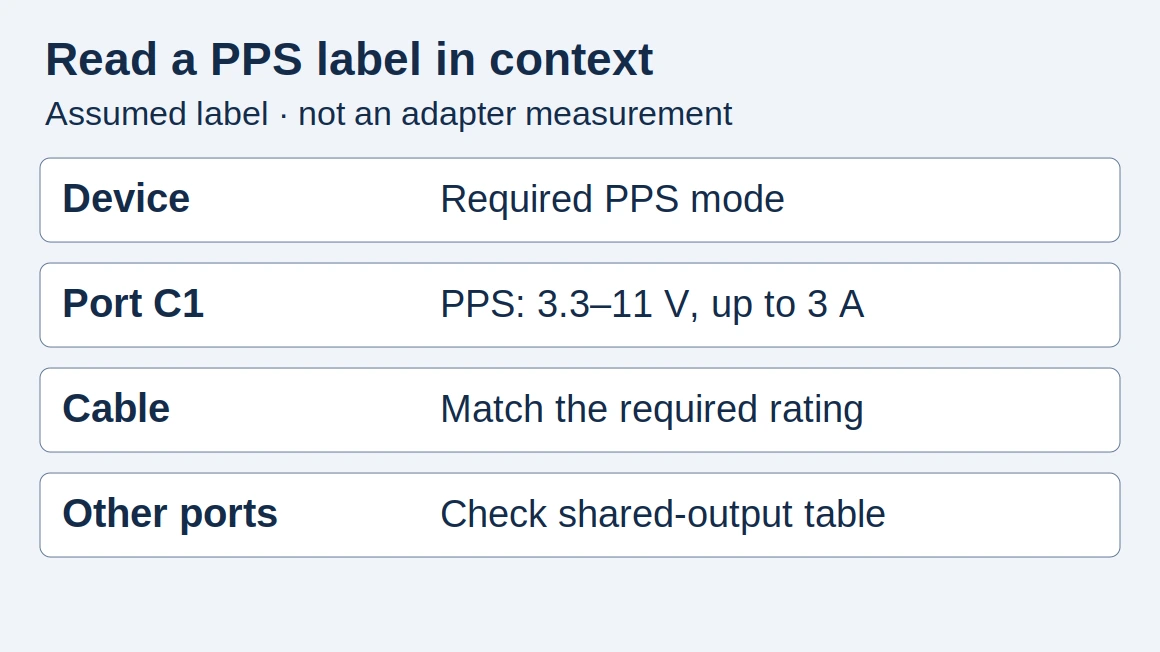
| PPS APDO, maximum voltage × maximum current | That product, not the voltage and current in the request (assertion 4.8.6.2#11) | Only if the product is at or under the available figure | Reserving the phone’s instantaneous PPS point. The spec reserves the APDO maximums. |
| Standard-A port inside the Type-C gang | Not allowed. Standard-A is its own group, minimum 5 V at 500 mA (assertions 4.8.6.1#3 and #4) | A 3C1A label still needs the manual’s gang table | Folding the USB-A port into the 100 W Type-C total. |
USB-IF section 4.8.6 separates two multi-port designs. An assured-capacity port behaves on its own. A shared-capacity port draws from one total, and every exposed port in that group has the same maximum and the same minimum. No port enters a contract for less than 7.5 W. That floor is also assertion 4.8.6.1#2: every Type-C port on a multi-port charger is 5 V at 1.5 A, and 5 × 1.5 = 7.5, independent of how many other ports are in use. A USB PD port offers at least 7.5 W (assertion 4.8.6.2#9).
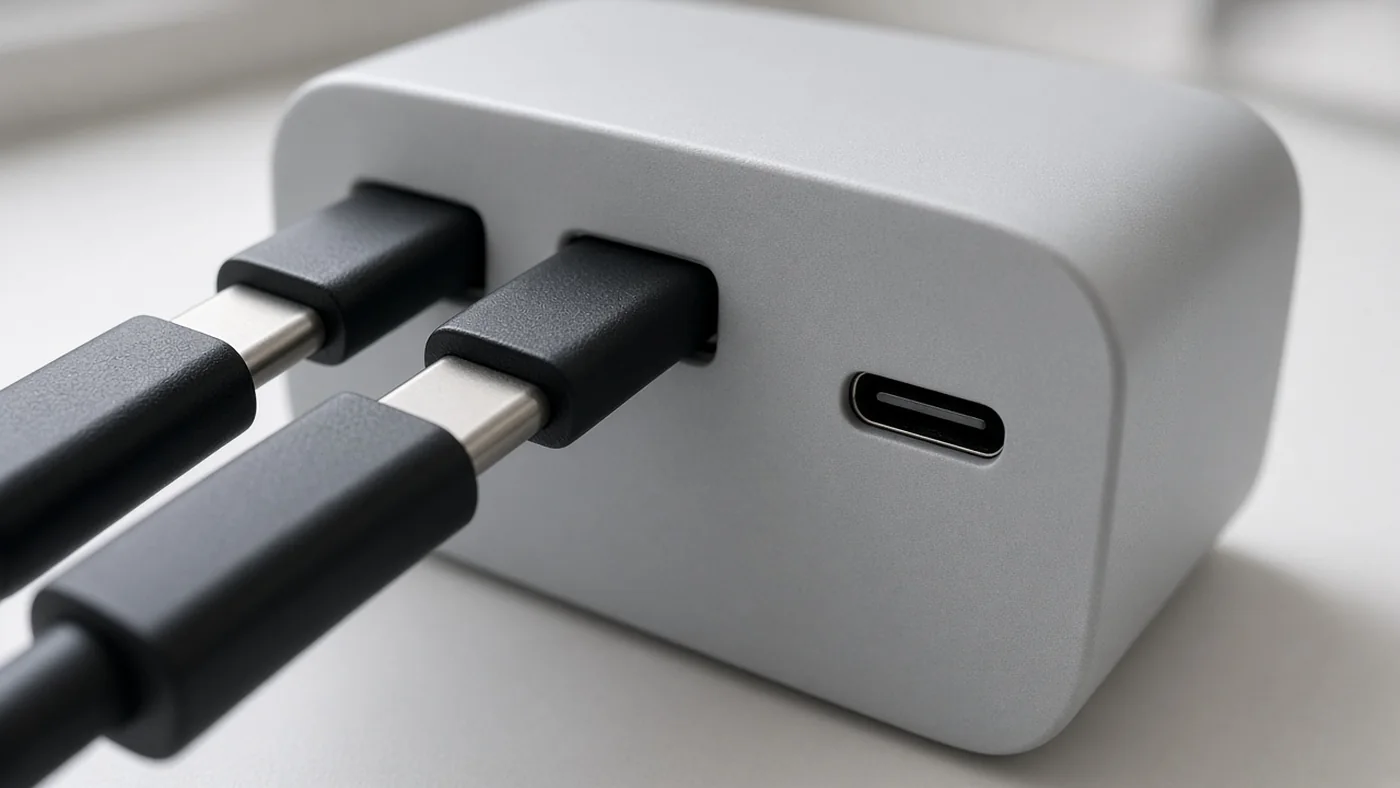
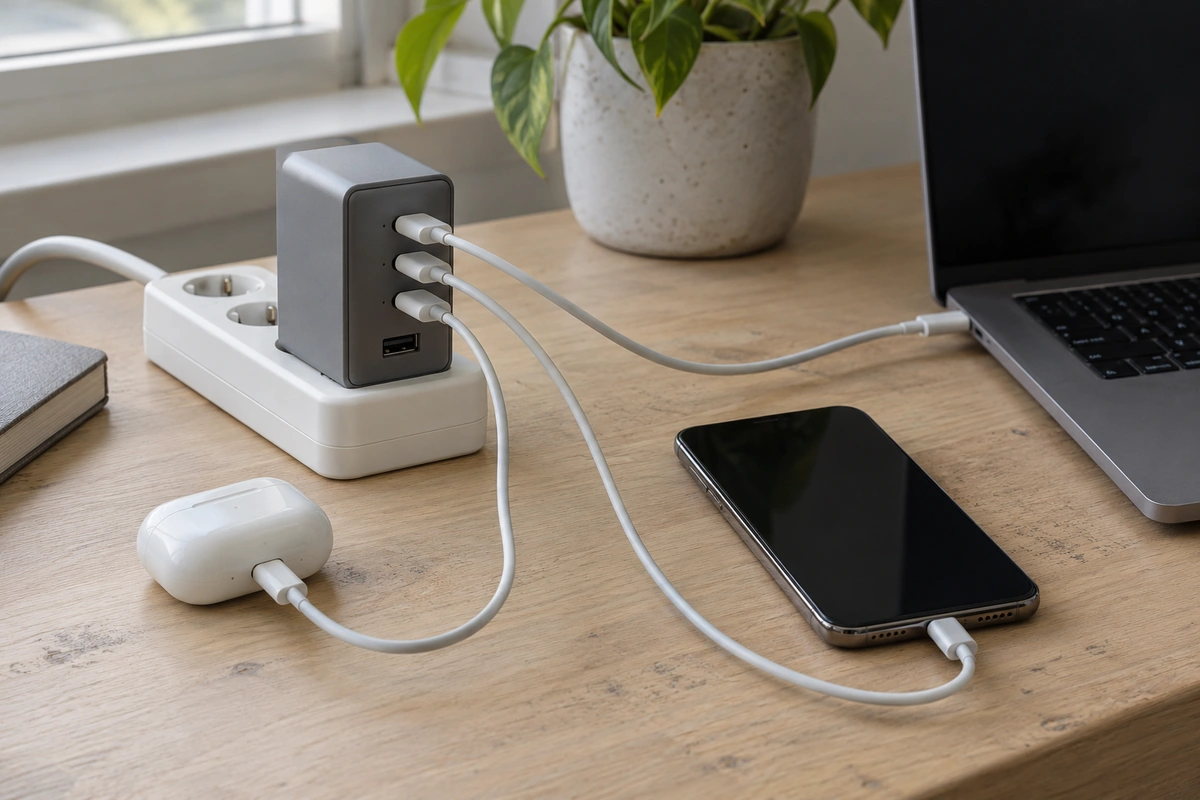
Two ports occupied and one open. The photo does not show a contract, a PDO, or a wattmeter.
Assertion 4.8.6.2#8 uses a different expression for what a remaining unattached port advertises: the lower of the port maximum, or total shared minus contracted power minus (number of unattached ports − 1) times minimum port power. For two unattached ports that subtracts one minimum, not two. Step 12’s available-capacity line subtracts 7.5 W times every other unattached port. Use step 12 for the contract limit. Using only the assertion’s (n − 1) term on a three-port 100 W gang would leave 92.5 W, which is 7.5 W above the step 12 figure.
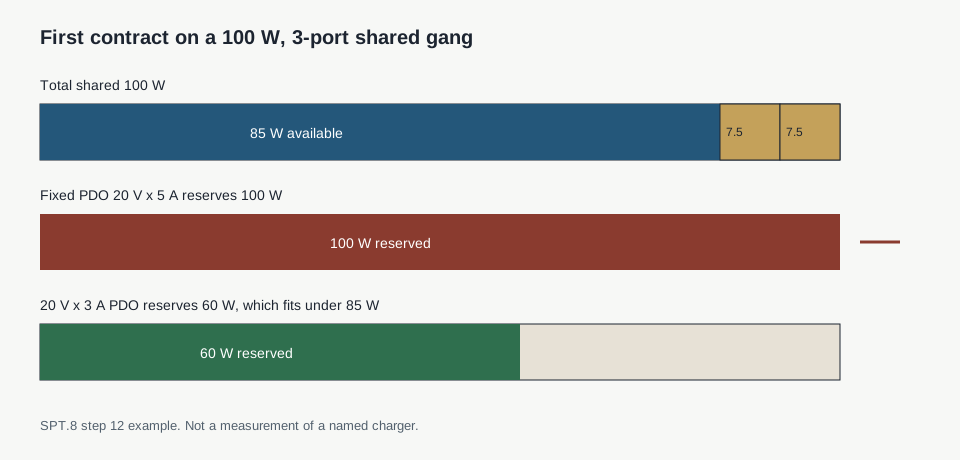
The top bar is the step 12 split before any contract. The middle bar is a 20 V × 5 A PDO. The bottom bar is a 20 V × 3 A PDO. Schematic of the arithmetic, not a lab trace.
Rules of thumb before you trust the badge
Rules of thumb. If fixed PDO power exceeds 85 W on a 100 W three-port shared gang, that PDO and two live sibling ports do not fit together under step 12. If the brick is assured capacity instead, assertion 4.8.6.2#1 says each source port is unaffected by the other ports, safety events aside, and this 85 W ceiling does not apply. The label has to say which design it is. “100 W” alone does not.
Within 3 seconds of the contracts changing, step 12 expects the gang to settle so the contracts add up to the group total, within 1 W, and no port is under 7.5 W. Assertion 4.8.6.2#6 requires every port in the group to reach its maximum offer within three seconds after the sink sets Capabilities Mismatch, and it allows that rise in steps. A pause while that happens is the subject of the multiport sharing guide. This page is the budget those messages are reallocating.
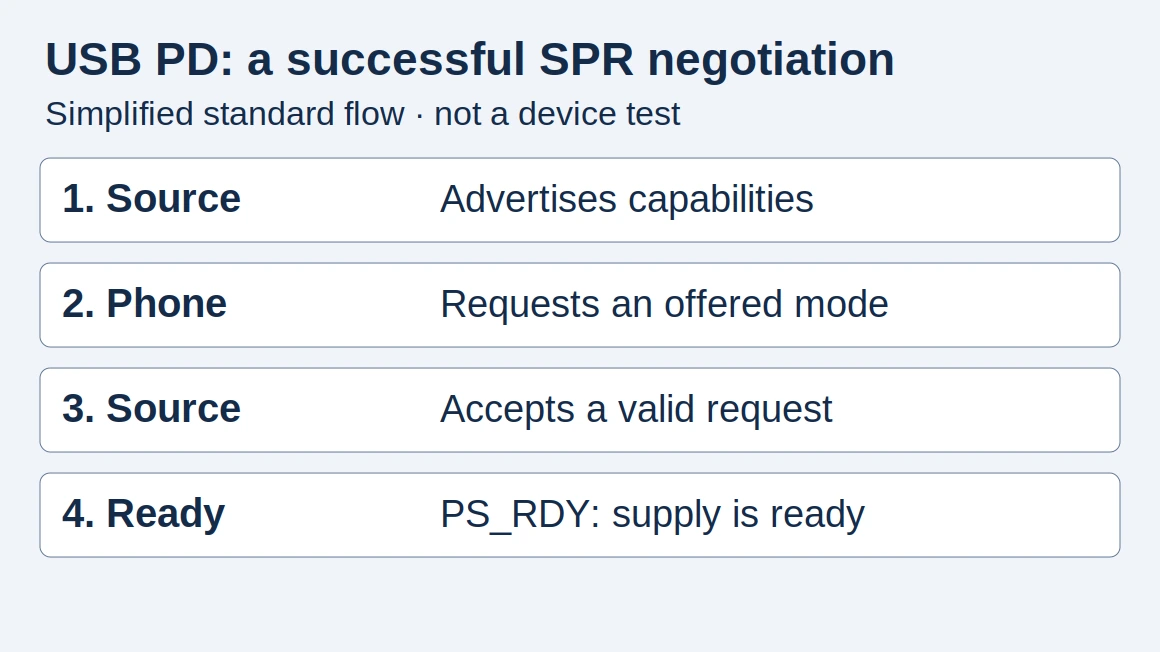
PPS details, including why the request is not the reserved power, sit beside the PPS guide. The message order Source_Capabilities, Request, Accept, PS_RDY is in the USB-C PD explainer.
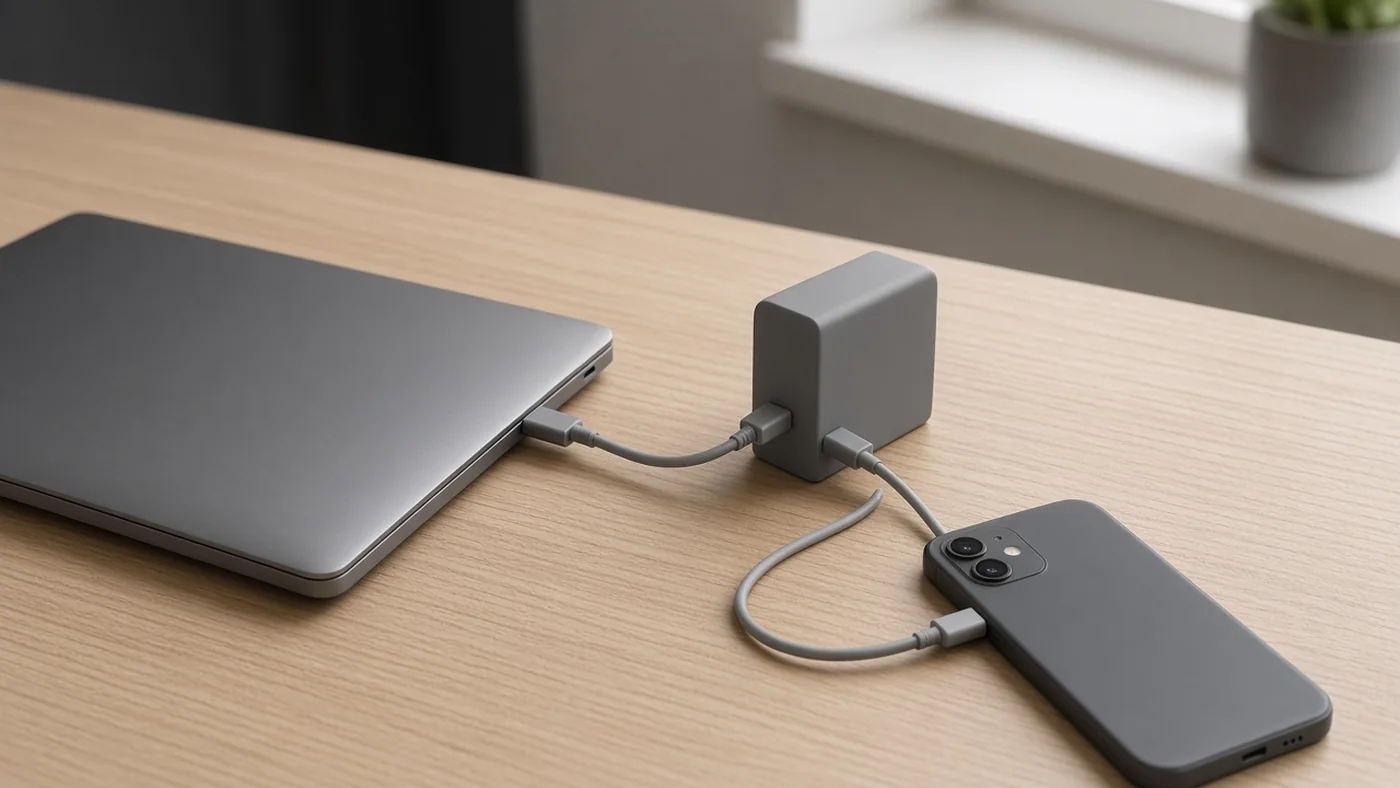
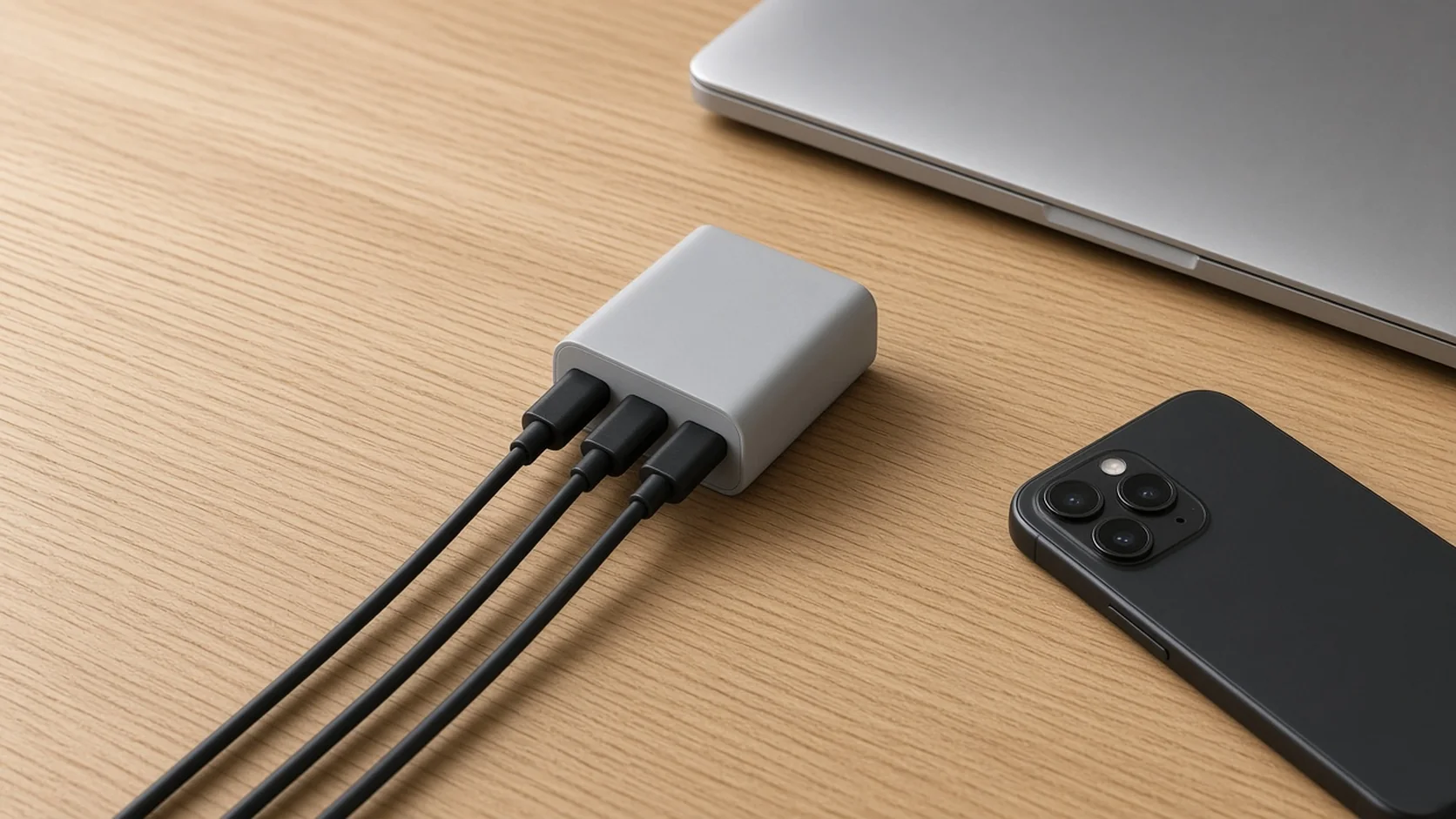
One brick feeding a laptop and a phone. The scene does not record how many watts each cable carries.
What the wrong reading costs
- A second brick. Buying another charger because the laptop fell off 100 W when a phone was attached, when the gang was never a 100 W simultaneous design.
- A brownout on the open ports. Reserving the requested current instead of the PDO maximum leaves too little held for the 7.5 W floors. Step 12 then fails in the direction of an over-contract.
- A USB-A surprise. The Type-A port is a separate group with its own 5 V at 500 mA floor. Treating it as a fourth slice of the 100 W Type-C total mis-sizes both gangs.
- A cable that cannot carry the PDO. A 20 V × 5 A contract is a 100 W reservation only if the cable and the port actually enter that PDO. The PD explainer records the 5 A cable distinction. This page does not retest cables.
- Renegotiation time. Every new contract recomputes the shared total and sends updated Source Capabilities (assertion 4.8.6.2#7). That is downtime on the laptop, counted in the three-second settle window, not a defective port by itself.
There is no sourced price difference here between a shared 100 W brick and an assured-capacity brick. The cost shows up as an extra adapter, a replaced cable, or a work session that reset.
Keep the gang type, the total watts, the PDO maximums, and the port count with the charging and power guides.
Method and sources
Figures are from USB-IF Source Power Requirements Test Specification revision 0.78, dated 6 May 2020: assertions 4.8.6.1#2 through #4 and 4.8.6.2#1, #6 through #11, and SPT.8 step 12. The 85 W, 60 W, and 100 W results are this page’s arithmetic on a stated 100 W total. They are not a test report for a product.
How this guide was prepared
Desk research from USB-IF Source Power Requirements Test Specification revision 0.78, 6 May 2020, with AI assistance for drafting. The 100 W arithmetic applies that document's shared-capacity rules to a stated total. It is not a measurement of a named GaN charger.
Sources and further reading
Found an error? See our corrections policy and research methodology.