UL 94 V-0 Rating: What It Means for Charger Casings
V-0 classifies how a plastic specimen behaves in a controlled flame test. Use the material-claim record to connect that evidence to the exact charger you are considering.
Mistaking a “V-0 casing” claim for complete-product certification risks overlooking the charger’s actual safety evidence. UL 94 V-0 is a classification for a plastic specimen’s behavior in a controlled flame test; it does not certify the complete charger.
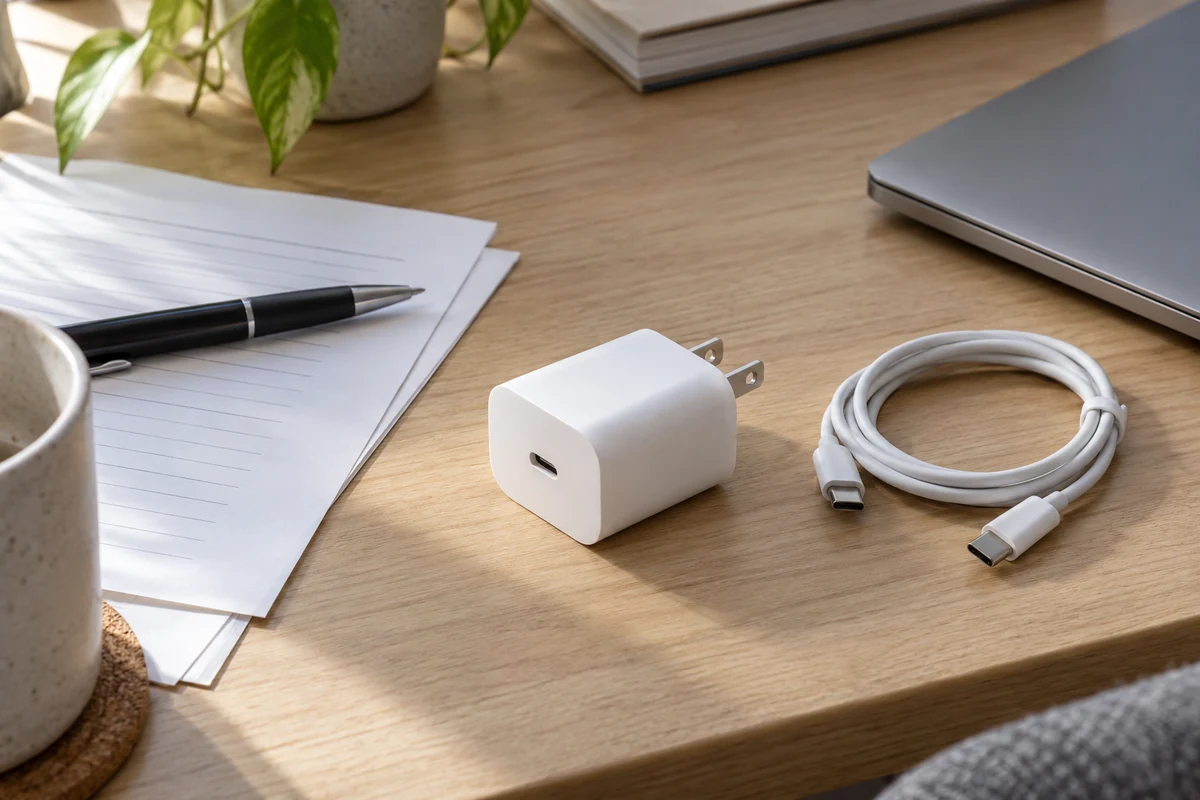
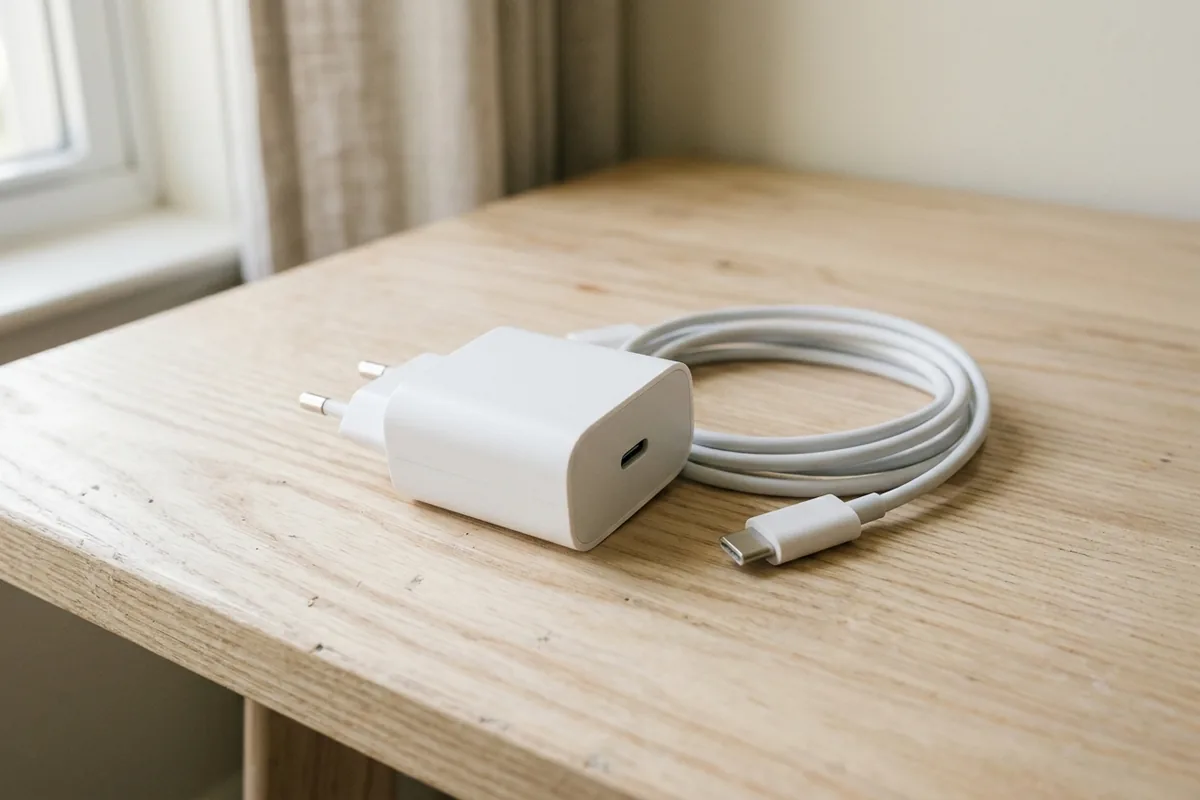
An unplugged white charger sits beside a disconnected cable on a wooden desk.
To interpret an “UL94 V0 rating,” read it as UL 94 V-0 and check the scope of the supporting document. A material name such as PC/ABS, a V-0 badge or a photograph of a casing cannot connect the claim to your charger by itself. Match the resin manufacturer and grade, covered thickness and color, and material record to the exact charger model. Then check the finished product’s safety evidence separately. The record below keeps those two checks together without treating either as a substitute for the other.
What does a UL 94 V-0 rating mean?
V-0 describes limited burning after the test flame is removed, along with limits on afterglow and whether falling burning material ignites a cotton indicator. It is a controlled specimen classification, not a promise that an operating charger cannot catch fire.
UL Solutions’ public combustion-test page describes the vertical test used for V-0, V-1 and V-2. Its table gives the following criteria. These are selected criteria from the public explanation, not a complete test procedure or instructions for testing a charger at home.
Scroll horizontally to see all columns if needed.
| Vertical-test criterion | V-0 | V-1 | V-2 |
|---|---|---|---|
| Burning after each flame application | At most 10 seconds | At most 30 seconds | At most 30 seconds |
| Total burning time across 10 flame applications | At most 50 seconds | At most 250 seconds | At most 250 seconds |
| Burning plus afterglow after the second application | At most 30 seconds | At most 60 seconds | At most 60 seconds |
| Dripping burning material ignites cotton below the specimen | Not permitted | Not permitted | Permitted |
| Burning reaches the holding clamp | Not permitted | Not permitted | Not permitted |
UL’s table specifies two flame applications of 10 seconds each. The 10-second V-0 afterflame limit is a separate quantity: it concerns burning after a flame application. It is not a safe exposure time for a charger, a temperature rating or a guarantee of survival in a fire.
V-0 has tighter burning-time limits than V-1 and V-2 in this test. V-1 and V-2 share those time limits, but differ on cotton ignition from drips. Saying “V-0 means no dripping at all” loses that distinction: the table’s criterion concerns ignition of the cotton indicator. UL also cautions that the thin-material classification VTM-0 uses a different method and is not equivalent to V-0.
Does “fire-retardant PC/ABS” identify a verified casing?
It does not identify the exact material record. Treat “fire-retardant PC/ABS” as the start of a document check: ask which manufacturer’s resin grade was used and what evidence applies to that grade in this casing.
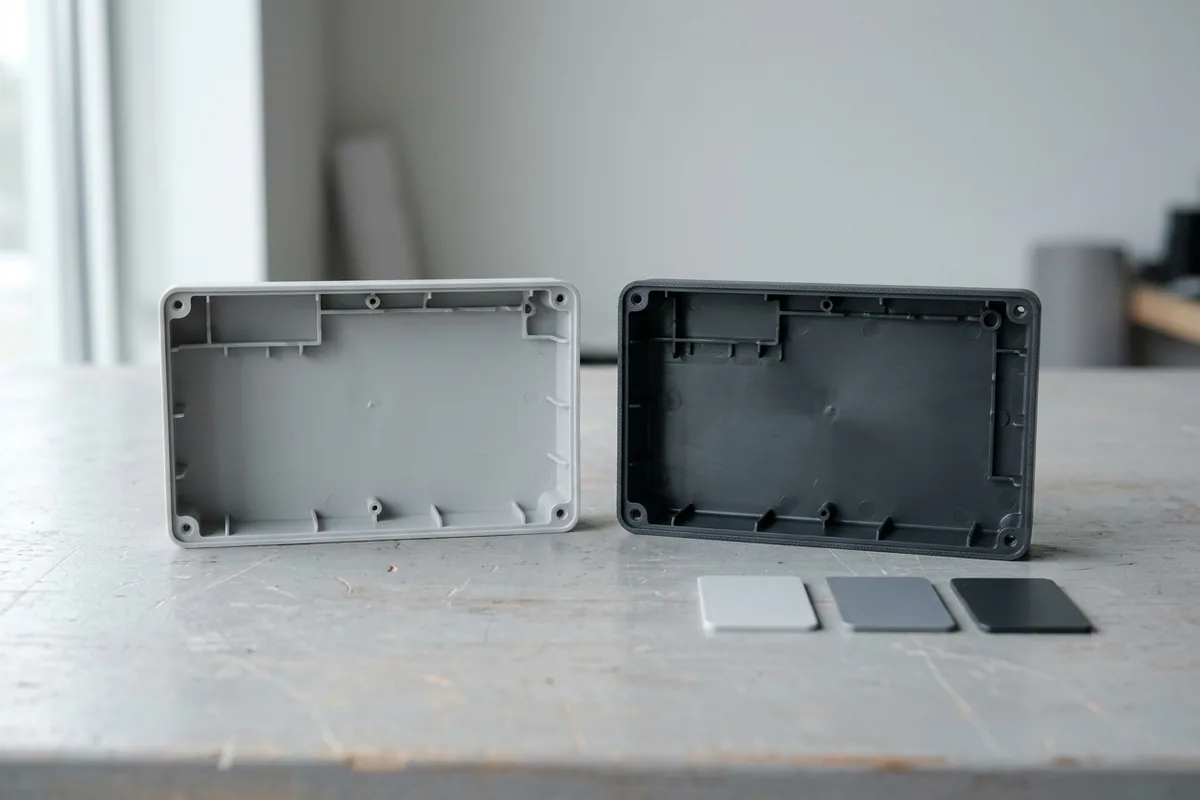
Empty plastic enclosure halves sit beside rectangular plastic coupons, with their edges visible.
A thin edge is a reason to check documented thickness, not evidence of a particular dimension. UL’s public Plastics Recognition Program agenda explicitly includes thickness recognition—minimum thickness or range—and colors to be tested. Record those conditions alongside the grade. Do not extend a result to a thinner wall, another color or a changed formulation without documentation covering the change.
For recognized materials, UL describes the Yellow Card as a digital record of tested polymer properties. Certified materials appear in UL Product iQ and UL Prospector. Ask for a traceable material record or test report, rather than relying on a cropped V-0 symbol. A report and a recognition record are different forms of evidence; record which one you actually have.
Even a matching material record needs a link to the part being purchased. Ask the charger manufacturer to identify that resin grade for the exact casing and product revision. A resin maker’s document alone does not establish what a charger factory put into a particular unit.
Copy this material-claim record
Record the material evidence and finished-product evidence on separate rows. Leave an entry blank or write “Unknown / verify on the unit” until you have a document or observation that supports it. This is a document reconciliation worksheet, not a certification checklist that you can pass by filling every cell.
Scroll horizontally to see all columns if needed.
| Field to reconcile | Your entry | Evidence to attach or reference |
|---|---|---|
| Finished charger model and revision | ________ | Unit label, packaging and model-specific documentation |
| Casing part or revision | ________ | Manufacturer’s identification of the casing used on that model |
| Resin manufacturer and exact grade | ________ | Material declaration linked to that casing |
| Formulation or grade suffix | ________ | Full grade designation and any documented change |
| Casing color covered by the claim | ________ | Applicable color designation in the material evidence |
| Applicable thickness, in mm | ________ | Material record’s minimum or range, plus documented casing thickness |
| Claimed classification | ________ | Exact classification on the report or material record |
| Material record or report identifier and date | ________ | Traceable original, issuer and record reference |
| Separate finished-product safety evidence | ________ | Record identifying the complete charger model, scope and market |
| Unresolved mismatch and next request | ________ | What is missing, who must clarify it and the document needed |
Keep the document references with the record so another reader can repeat the comparison. A manufacturer may need to supply the casing’s material and thickness details; a consumer should not open a mains charger to obtain them.

A charger, cable, paper folder and plastic sample occupy separate areas of a desk.
What should you conclude from the documents?
Conclude only what the documents establish for the item they identify. A matching material record supports the material claim within its stated conditions; it does not complete the finished-product check.
Scroll horizontally to see all columns if needed.
| What you have | What you can conclude | Next action |
|---|---|---|
| Only “V-0 PC/ABS” in a listing | The seller makes a material claim; its applicability remains unresolved | Request the exact grade, supporting record and link to the casing |
| A material record, but no casing thickness or grade declaration for this charger | Evidence exists for a material, with an incomplete link to the product | Request the missing model-specific information |
| A grade, color or thickness mismatch | The supplied document does not establish the stated casing claim | Obtain applicable evidence or a documented correction |
| Matching material evidence and a model-specific end-product safety record | You can assess each claim within its own documented scope | Check the end-product record and keep both references |
UL’s component-recognition explanation states that recognition applies to components intended for incorporation into a larger product, under conditions of acceptability. It is not certification of a complete standalone product. A recognized resin therefore cannot stand in for a finished charger’s safety certification.
Use the UL, CE and FCC charger-marks guide for the separate model-and-mark check. An unavailable or incomplete document leaves a claim unverified; it is not, by itself, proof of a counterfeit product. For charging profiles and cables, return to Charging & Power: a casing classification supplies neither a charging-speed result nor a compatibility verdict.
Method and sources
Updated October 2026. This is desk research based on UL Solutions’ public pages accessed on 15 October 2026, including its combustion-test table, explanation of UL 94’s limited scope, component-recognition guidance and public Yellow Card information. The linked webinar agenda supports the thickness-and-color check; its videos and the gated Yellow Card e-guide were not reviewed. We did not consult the full UL 94 standard, test or open a charger, or verify a particular resin or product certification. The blank record above is our editorial tool for organizing documents, not an issued test report.
How this guide was prepared
Desk research with AI assistance, using public UL Solutions pages fetched on 15 October 2026. The comparison summarizes UL's public vertical-test table, not the full standard. The material-claim record is an editorial worksheet. No charger or resin was tested, opened or certified for this article, and no particular product or material recognition record was verified.
Sources and further reading
- Combustion (Fire) Tests for Plastics — UL Solutions. Accessed .
- Understanding UL 94 Rating Certifications and Limitations — UL Solutions Code Authorities. Accessed .
- The UL Component Recognition Classification — UL Solutions. Accessed .
- How to Read the UL Solutions Yellow Card — UL Solutions. Accessed .
- Plastics Recognition Program Webinar Series: public agenda — UL Solutions. Accessed .
Found an error? See our corrections policy and research methodology.