How to Evaluate a Supplier Before Placing a First Order
A deposit to the wrong legal entity, or a file for a different model, can stall a first order. Match the entity, the model file, the remedy owner, and the pilot result before you pay.
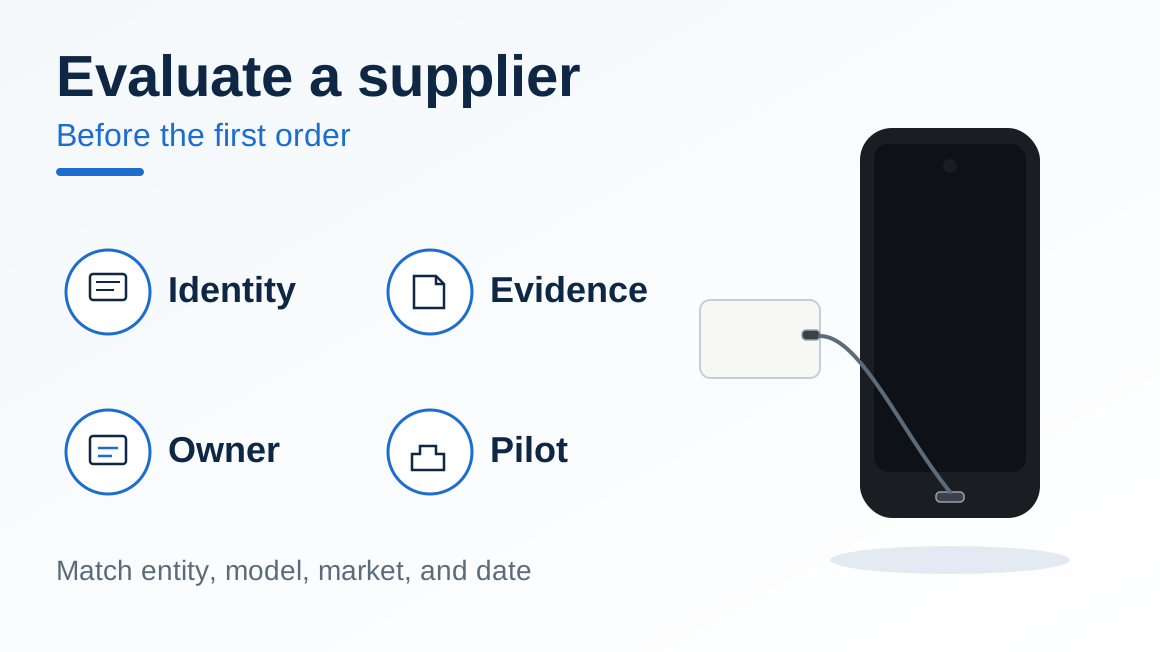
A deposit sent to the wrong legal entity, or a conformity file that names a different model, can leave you holding a first order you cannot clear for the destination market. Evaluate the supplier by matching four records before you pay: the contracting entity, the product file for this model and market, a person who can authorize a remedy, and a pilot result against criteria you wrote first. Those checks sit under the wider wholesale sourcing guides.
You evaluate a supplier before a first phone or accessory order by matching four records on the same transaction: the legal entity that will sign, product evidence for this model and destination, a named person who can authorize a remedy, and a pilot result defined before the deposit. For an EEA product, the European Commission assigns the manufacturer the conformity assessment, the technical documentation, the EU declaration of conformity, and the CE mark. For US equipment authorization, eCFR text of 47 CFR § 2.906 displayed on 18 October 2026 makes Supplier’s Declaration of Conformity a responsible-party procedure, and § 2.909 requires that party to be located in the United States. Section 2.907 makes certification an FCC or Telecommunication Certification Body approval. Both routes cover units identical to the tested sample. A registry hit or a printed logo still leaves those four records to match.
Scroll horizontally to see all columns if needed.
| Stage | Record you keep | Pause when |
|---|---|---|
| Identity | Registry query, contract, invoice, and payee | A name still lacks a written link |
| Evidence | Model, entity, market, and document date on one file | The file names another product or market |
| Owner | Written answer and the person who can authorize a remedy | A material question has no owner |
| Pilot | Criteria, opened-unit count, and disposition | A failed or incomplete result has no disposition |
Stage 1: Commercial Standing & Legal Identity
The company that signs is the company you can look up, and the company that receives the money.
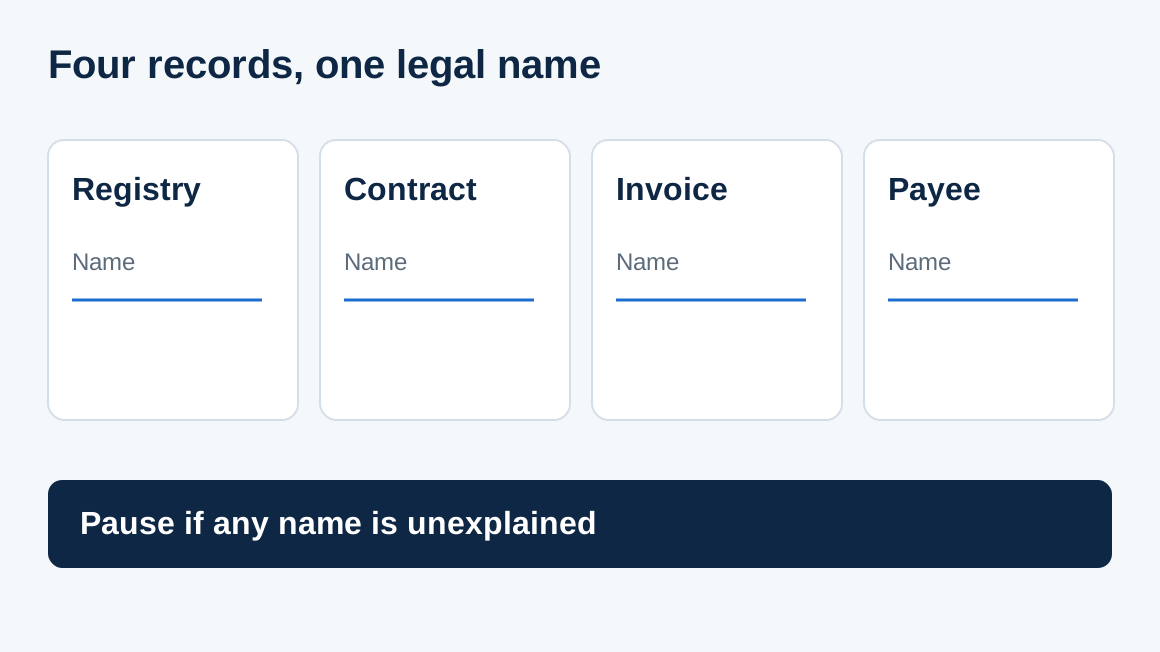
Schematic, not to scale. Fill the four name lines from the documents in hand. The figure does not depict a particular company.
For a mainland China company, start from the Chinese legal name and the Unified Social Credit Code on the business license the supplier gives you. The State Administration for Market Regulation notice of 24 November 2023 says a member of the public can query the National Enterprise Credit Information Publicity System after a real-name login by entering the enterprise name, the Unified Social Credit Code, or the registration number, then opening basic information and scrolling to the reputation block. That notice says the block displays named awards: the China Quality Award, provincial government quality awards, and China Time-honored Brand. Save the identifier you typed, the query date, and the result. An award line is the reputation record that notice describes. Production of this phone or this accessory is a separate record. The China sourcing workflow is the step sequence for lining the license up with that query.
On an EEA file, the Commission’s manufacturer page says the EU declaration of conformity must include the manufacturer’s name and address, the essential characteristics of the product, the notified body’s identification number where a body took part, and a legally binding signature. Compare that name and address with the contract party.
If the invoice name or the payment beneficiary differs from the contract party, hold the deposit. Ask for a written explanation of the relationship, then compare that explanation with the registry result you saved. Section 2.909(e), as displayed on 18 October 2026, says that in a transfer of control such as a sale or merger of the responsible party, the new entity bears continued compliance of the equipment. A purchase of the old company is a new name to match, not a reason to skip the query.
Record whether the contract party is the manufacturer named on the declaration or a separate seller. For the named manufacturer, the file is the declaration and the technical documentation. For a separate seller, record the seller’s contract role and the path to the manufacturer who signs the declaration, including who answers for a defect.
Takeaway: Confirm the contracting entity, the payee, and the manufacturer named on the declaration before you score factory capability.
Stage 2: Technical Competency & Quality Infrastructure
Ask which operations this supplier will perform on this model, and which destination documents name this model.
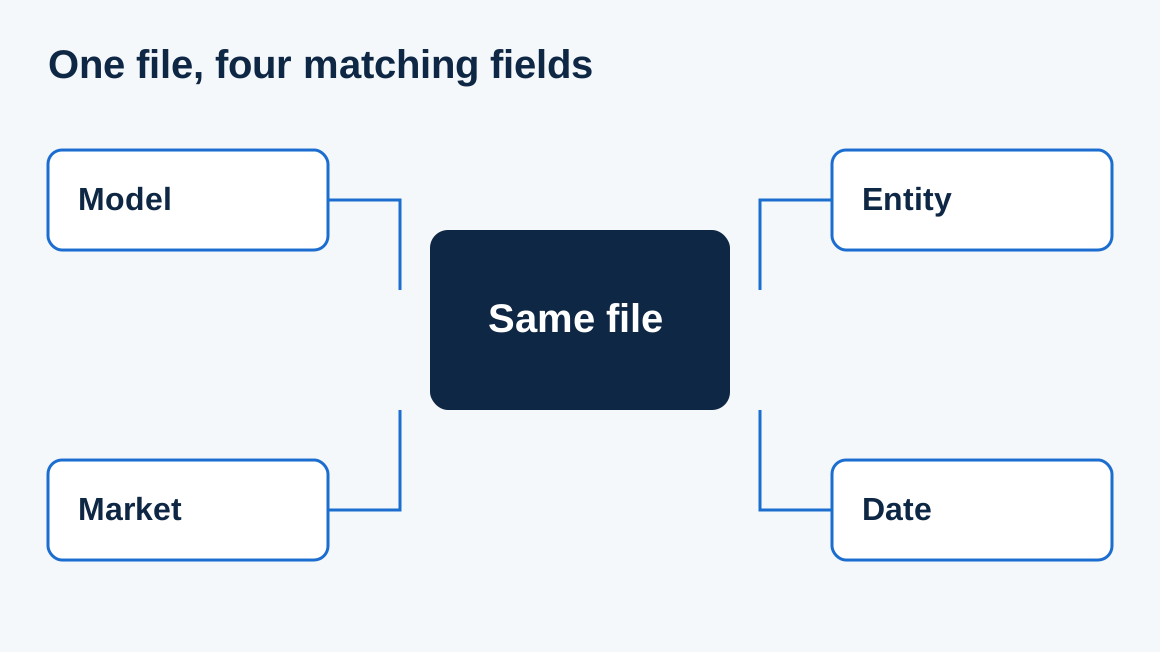
Schematic, not to scale. A file that names a different model, entity, market, or date is a different file.
Scroll horizontally to see all columns if needed.
| Check | What a useful answer names | Dominant failure mode | Prevention |
|---|---|---|---|
| Who builds and who sells | Contract party, and the manufacturer named on the declaration | A trading company treated as the manufacturer on the declaration | Both names written down, plus the path between them |
| EEA declaration | Name, address, product characteristics, signature, and a notified-body number only if a body took part | A CE mark with no declaration for this model | Mark and declaration read together |
| US route | SDoC responsible party located in the United States, or the certification grantee | A non-US factory contact asked to sign as the SDoC responsible party | Party name and US location, or grantee, matched to § 2.909 |
| UL record | A Product iQ hit for this product or this component | A component record read as a finished-product certification | Write down which of the two the hit is |
| RoHS file | An EU declaration plus technical documentation | A logo page with no declaration and no technical file | Ask for the declaration and the technical file |
| Unit identifier | Type, batch, or serial number on the equipment | A carton label and a blank unit | Identifier on the unit itself |
The eCFR pages state that the eCFR is not an official legal edition of the CFR. The § 2.906 text displayed on 18 October 2026 carries an amendment note through 90 FR 38066 (7 August 2025). The § 2.907 text displayed the same day carries an amendment note through 90 FR 38067 (7 August 2025). The § 2.909 text displayed that day carries an amendment note through 88 FR 7623 (6 February 2023).
Under § 2.906, Supplier’s Declaration of Conformity is a procedure in which the responsible party, as defined in § 2.909, makes measurements or completes other procedures the Commission finds acceptable. Section 2.906(a)(2) says submittal of a sample or representative data to the Commission is not required unless the Commission requests it under § 2.945. Section 2.906(b) applies that declaration to items subsequently marketed that are identical, as defined in § 2.908, to the sample tested. Section 2.906(a)(1) says the measurements must not be made at a facility owned, controlled, or directed by a prohibited entity as defined in § 2.902. Section 2.906(d) says equipment produced by an entity on the Covered List established under § 1.50002 cannot use the SDoC route, and the certification rules apply. This page does not reproduce that list.
Under § 2.907(a), certification is an equipment authorization approved by the Commission or issued by a Telecommunication Certification Body under the Commission’s authority, based on representations and test data the applicant submits. Section 2.907(b) attaches that grant to units the grantee later markets that are identical to the tested sample, except for permissive changes or other variations the Commission authorizes under § 2.1043. Section 2.909(a) makes the grantee responsible for compliance. If another party modifies the radio-frequency equipment and is not working under the grantee’s authorization in § 2.929(b), that party is responsible.
For SDoC, § 2.909(b) says the responsible party must be located in the United States. The same subsection sets that party as the manufacturer, or the assembler when a system is assembled from parts and is subject to SDoC. If the equipment or system is imported, the responsible party is the importer. A retailer or original equipment manufacturer may agree with that party to assume the responsibilities and become the new responsible party. If someone outside that authority modifies the equipment, the modifier becomes the responsible party when located in the United States, and the importer becomes the responsible party when the equipment is imported after the modification. A supplier contact outside the United States can still build the goods. The SDoC signature belongs to the US party § 2.909 names.
The Commission’s manufacturer page, accessed 18 October 2026, puts four jobs on the manufacturer before the product is traded on the EEA market: the conformity assessment, the technical documentation, the EU declaration of conformity, and the CE mark. You identify the applicable directives or regulations and the harmonised standards. More than one act can apply to the same product, and horizontal chemical or environmental legislation can apply as well. For products the page describes as higher risk, where the manufacturer cannot check safety alone, a notified body appointed by national authorities performs the safety check, and the manufacturer affixes the CE mark after that. The page says a notified body, in most cases, verifies the manufacturer’s quality management, the design, and compliance with the essential requirements, and that the manufacturer may use another route in which the body verifies the product type and then the conformity of the final products with that type. The certificate indicates what was verified. Read the certificate for those items and for this product type. A quality-management sentence about a different product is a different file. NANDO is the database the page names for finding notified bodies by legislation or by country.
The manufacturer or the authorised representative established in the European Union keeps the technical documentation for the period the applicable regulation or directive specifies. The page does not print one retention period for every product. If the file you are shown has no issue date and does not name the act that sets retention, ask which act applies before you treat the file as complete for this order. The CE mark goes on the product, or on the packaging and the accompanying document when the product itself cannot carry it. It must be visible and legible. If a notified body took part, its identification number is displayed. The page says manufacturers must not affix the CE mark to products outside the scope of a regulation or directive that provides for it.
Rule of thumb: If the CE mark on the sample is under 5 mm in vertical height, it misses the minimum on that Commission page. The same page says the parts of the mark share one vertical dimension, and that enlarging or reducing the mark keeps the stated proportions. The 5 mm figure is a marking dimension, accessed 18 October 2026, not a charging or battery limit. Ask for a corrected mark on the sample you will keep.
UL Solutions’ Product iQ page, accessed 18 October 2026, describes Product iQ as the search for UL certification information on a product or a component. The page says you can start from a keyword, a CCN, a file number, an assembly number, a design number, a system number, or a construction number when you do not have one certification number. Write down whether the hit is the finished product or a component. The same page says you can ask the UL Solutions Customer Experience Center about the validity of a given certification, and it prints the phone number 877-854-3577 and the email CEC@ul.com. The charger mark guide separates what a UL record, a CE declaration, and an FCC authorization each cover.
The Commission’s RoHS 2 FAQ is dated 12 December 2012. Question 8.2 says that when a product is placed on the market, the manufacturer or the authorised representative established in the EU draws up an EU declaration of conformity as part of the conformity assessment. For RoHS 2, that declaration has to show compliance with the substance restrictions. The same answer cites Article 5 of Commission Decision 768/2008/EC for a single declaration covering the relevant Union acts, and it encourages that single declaration. Question 8.3 says Article 7(b) of RoHS 2 requires the technical documentation and the internal production control procedure in line with module A of Annex II to that decision, and it points to that annex for what the documentation contains. Question 9.6 names EN 50581:2012 as the harmonised standard that specifies technical documentation the manufacturer may compile for the substance restrictions, read with module A. Question 8.11 says the CE mark symbolises conformity with the applicable EU requirements and that the appropriate conformity assessment procedures have been carried out. Question 8.12 says that from 2 January 2013 the CE mark is the only marking that attests conformity with RoHS 2, and that markings likely to mislead third parties about the meaning or form of the CE mark are prohibited. Question 8.14 says Article 7 requires manufacturers to mark equipment with a type, batch, or serial number, or another element that allows identification, and that the choice among a product line, a batch, or individual serial numbers is a business decision. This FAQ does not list later amendments. Match the declaration’s named acts to the placing-on-the-market date for your goods.
If the supplier describes aging or full-load operation before packing, ask what share of this lot is included and ask for that lot’s log. Leave the share blank until they write it down. Ask for the test report the technical file relies on, and for the calibration record of each instrument that report names.
Common mistake: Treating a UL component hit, or a declaration for another model, as proof for this finished unit.
Takeaway: Check model, entity, market, and document date on the same file.
Stage 3: Communication Transparency & Problem Escalation
Put one material discrepancy through the channel you will use after the order. Use a model code that differs from the declaration, a beneficiary that differs from the contract, or a proposed part change. You are watching who answers, and whether the answer names a person who can approve a remedy.
Freeze the limits in that question with the specification comparison guide, so the supplier is answering a missing value rather than a slogan. Agree in writing how a delay or a substitution is reported and who approves it. A part change matters for US authorization because § 2.906(b) limits SDoC to items identical to the tested sample, and § 2.907(b) limits the grant the same way except for permissive changes or other variations authorized under § 2.1043. Section 2.909(d) says that if a new party becomes responsible because of modifications and does not obtain a new equipment authorization, the equipment is labeled to state that the product has been modified and to name the party who modified it. Hold the substitution until you have the written approval and a check of whether the existing authorization still covers the changed goods.
Write down the person who answers technical questions and the person who can authorize rework, replacement, or a stop. When the seller is not the manufacturer on the declaration, write down how you reach that manufacturer.
Takeaway: Keep the issue, the response, and the decision owner in the same written record.
Stage 4: Pilot Order Controls & Risk Mitigation
Set the pilot to the number of units you can open and to the loss you can carry if the lot fails. This page does not set a universal quantity.
Unexamined units = N - n
Coverage = n / N
Worked example. You write a plan that sets N = 40 units and opens n = 8 units. Unexamined units = 40 - 8 = 32 units. Coverage = 8 / 40 = 0.20 of the pilot. These two inputs are the plan in this example. They are not a recommended order quantity, a minimum order, or a defect rate. The 32 units you leave closed stay under the disposition you wrote. One failed unit among the 8 is a pause for the lot.
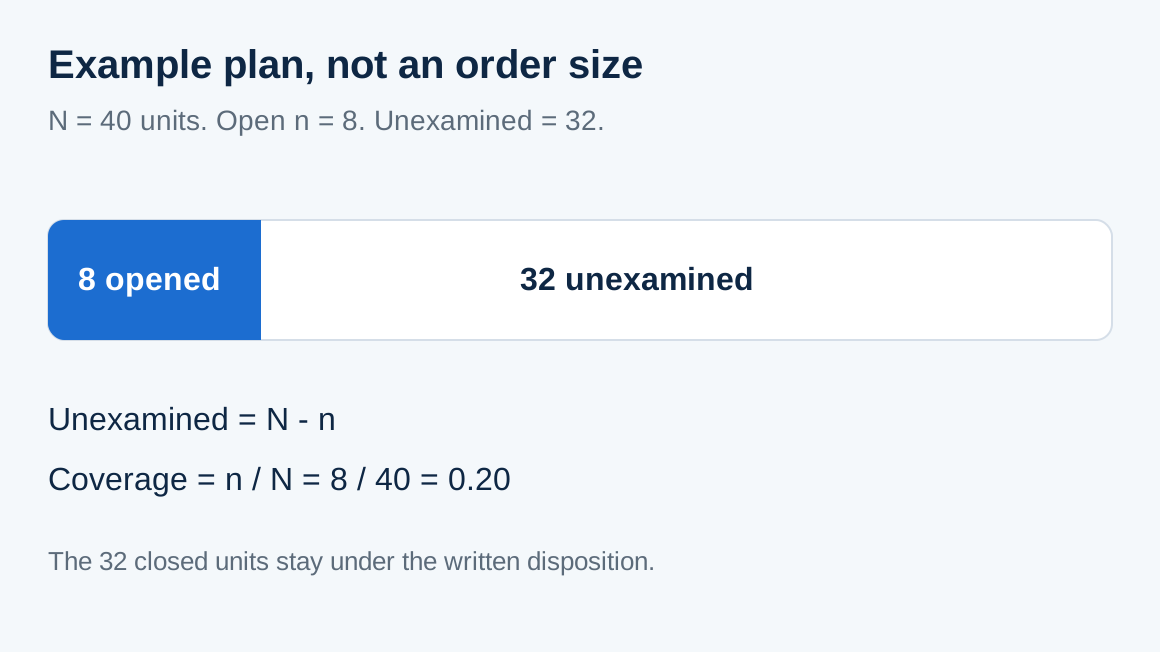
Schematic of the worked example above. The 40, 8, and 32 are inputs for the arithmetic, not a sample size this page requires.
Agree the inspection scope, the defect definitions, and the failure disposition before anyone releases goods or money. The quality-control checklist is the unit record to fill while you open samples. Sampling leaves the unopened units unobserved, which is why the disposition has to say what happens to them.
Scroll horizontally to see all columns if needed.
| Hidden cost | What triggers it | What to record |
|---|---|---|
| Repeat inspection | An opened unit fails | Hours and who repeats the check |
| Return freight | Goods go back | Who pays, from the contract |
| Units you will not sell | Nonconforming pieces held out of the sale | The count |
| A new authorization file | A change so the goods are no longer identical to the tested sample | The new document date |
| A held deposit | A name or file mismatch still open | The date payment is allowed to move |
The lower unit price guide divides total modeled cost by usable units. The dollar amounts on that page are assumed inputs for its worksheet. Put your own figures in your file, and keep each loss in one column so you do not add it twice. Before you release a deposit, walk the first-order risk checklist so payment, inspection, and the transport document stay separate events.
A repeat order from the same entity, on the same model file and the same written specification, uses the receiving record. A change of entity, model, market, or plant starts these four stages again.
Takeaway: An open discrepancy gets a written remedy or a written pause before any larger release.
Copy this record into the order file. It is a buyer worksheet. It is not a form addressed to Phone Gadgets.
Entity and role: ___
Registry identifier, query date, and result: ___
Contract, invoice, and payee names, and the written link if they differ: ___
Model, market, and document date: ___
Declaration or authorization route, responsible party or grantee, and reference: ___
Discrepancy, written response, and decision owner: ___
Pilot N, units opened n, result, and disposition: ___
Go or pause, with the date: ___
How this guide was prepared
Compiled on 18 October 2026 from the European Commission page on CE marking for manufacturers, the eCFR text of 47 CFR §§ 2.906, 2.907, and 2.909 displayed that day, UL Solutions' Product iQ description, the Commission's RoHS 2 FAQ dated 12 December 2012, and the SAMR notice of 24 November 2023. The eCFR pages state that the eCFR is a continuously updated online version of the Code of Federal Regulations and not an official legal edition. The four stages are a document-matching sequence for the buyer's own file. Phone Gadgets does not audit factories or endorse suppliers.
Sources and further reading
- CE marking: manufacturers — European Commission. Accessed .
- 47 CFR § 2.906 Supplier's Declaration of Conformity — eCFR, Office of the Federal Register. Accessed .
- 47 CFR § 2.907 Certification — eCFR, Office of the Federal Register. Accessed .
- 47 CFR § 2.909 Responsible party — eCFR, Office of the Federal Register. Accessed .
- Product sourcing and certifications database (Product iQ) — UL Solutions. Accessed .
- RoHS 2 FAQ, 12 December 2012 — European Commission. Accessed .
- 国家企业信用信息公示系统上线“信誉信息”板块 — State Administration for Market Regulation (SAMR). Accessed .
Found an error? See our corrections policy and research methodology.